Featherless

Featherless is a serverless platform designed for the deployment and execution of AI models, facilitating seamless integration with the Hugging Face ecosystem. By abstracting away the complexities of infrastructure management, Featherless enables developers to focus on their applications and AI models, offering an efficient and scalable solution for various AI-related tasks.

General
AuthorFeatherless
Relese date2020
WebsiteFeatherless
Documentationhttps://featherless.ai/docs/getting-started
Discordhttps://discord.com/invite/7gybCMPjVA
TypeAI deployment platform

Key Features

  • Serverless Architecture: Eliminates the need for manual server management and supports automatic scaling.

  • Seamless Hugging Face Integration: Provides effortless access to a vast library of pre-trained models from Hugging Face.

  • Support for Multiple AI Models: Compatible with large language models (LLMs), text-to-speech, image generation, and speech-to-text applications.

  • API-First Approach: Designed to easily integrate AI capabilities into new or existing applications through APIs.

  • Cost Efficiency: Operates on a pay-as-you-go pricing model, optimizing costs by charging only for the resources used.

  • Scalability and Performance: Capable of automatic resource scaling to handle varying levels of demand without manual input.

Use Cases

  • Application Development: Incorporate AI functionalities like text analysis, image processing, and speech recognition into web and mobile apps.

  • Data Science and Research: Deploy pre-trained models for data analytics, machine learning research, and rapid prototyping.

  • Content Generation: Utilize AI for automated content creation, including text generation, voiceovers, and image synthesis.

  • Customer Interaction Platforms: Implement conversational agents and chatbots powered by large language models.

  • Accessibility Tools: Create applications that assist with real-time text-to-speech and speech-to-text conversions, enhancing accessibility.

Get Started Building with Featherless

To start building with Featherless, visit the official documentation for comprehensive guides and API references. Begin by signing up for an account, exploring available pre-trained models, and following step-by-step tutorials to deploy your first AI model in a serverless environment. With Featherless, developers can create powerful, scalable, and cost-effective AI-driven applications with ease.

Featherless top builders

Explore the top contributors showcasing the highest number of Featherless app submissions within our community.

Featherless AI technology page Hackathon projects

Discover innovative solutions crafted with Featherless, developed by our community members during our engaging hackathons.

Pocketful By Band

Pocketful By Band

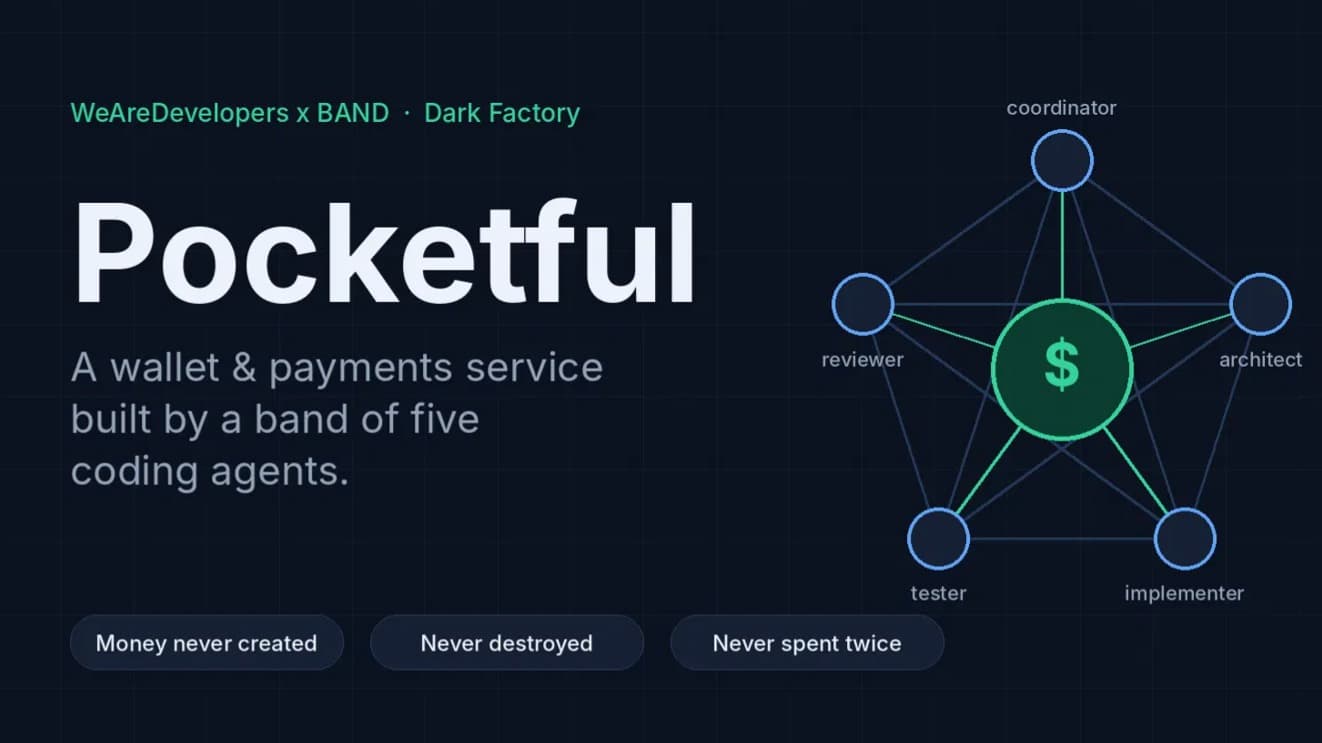
Pocketful is our entry for the Dark Factory hackathon, pocketful track. It is a wallet and payments service where people hold money, pay each other by handle, request money, split bills and settle up, and where money is never created, destroyed or spent twice, even with concurrent requests, retries and rounding. The factory. Five distinct coding-agent seats work together in one BAND Desktop room, running open-source models through Featherless and OpenCode: Coordinator splits each stage into scoped tasks and assigns work by @handle with the full task in every handoff. Architect designs the data model, invariants and concurrency plan before code is written. Implementer builds one scoped change at a time and commits it. Tester runs the checks independently and posts reproducible evidence. Reviewer judges the work against the written specification and sends weak work back with concrete fixes. The mandates are deliberately generic. They describe how a seat works (what it owns, how it hands off, when it rejects), not what is being built, so another team could point the same band at a different problem. FACTORY.md and the mandates folder describe how to stand it up. What it built. Four cumulative stage folders, each a complete service with its own Dockerfile and RUN.md, copied forward and extended so earlier behaviour is preserved: Stage 1: a JSON API with signup and login, payments, requests, splits and net settlements, idempotency keys on write paths, exact integer minor-unit arithmetic, and state export/import. Stage 2: a browser UI served by the same service (balance and pay, activity feed, requests and splits), plus holds and partial captures. Stage 3: payment corrections with revision history, as-of balance views and statements. Stage 4: refunds and batch corrections.

Factory: Four-Seat FactoryThat Proves Its Own Work

Factory: Four-Seat FactoryThat Proves Its Own Work

The Band: The factory operates four specialized seats over the Band Agentic Mesh connected to an OpenCode headless adapter: - Foreman: Coordinates work intake, breaks stage specs into REQ-numbered handoffs, and ensures consensus before advancing. - Smith: Implements service code, Dockerfile, and RUN.md, committing atomically to the repository under `Smith <[email protected]>`. - Inspector: Independent reviewer from a different model family. Independently executes test suites in clean environments and issues pass/rejection verdicts mapping each REQ ID to reproduced command output. - Stresser: Adversarial tester probing edge conditions (concurrency, idempotency replays, state restore, conservation of funds). Why the Mandates are Generic: All mandate files (`mandates/*.md`) are strictly task-agnostic standing operating procedures. They enforce: - Zero track-specific endpoints, route names, status codes, or domain nouns (verified by mechanical AST and regex linting). - Explicit handoff contracts and REQ-ID evidence mapping. - Dark-factory protocol: auto-rejecting questions to prevent stalling or human steering. The same band mandates can build completely different services simply by swapping the dispatch brief. How It Catches and Recovers from Bad Work: Quality assurance is built into the workflow through independent reproduction and adversarial probing: - The Inspector refuses to accept claimed outputs without running checks independently. - When defects are detected, exact terminal error logs are returned to Smith with structured rejection messages. - Smith applies revisions and re-submits until all stage suites and isolated checks pass. Measured Results, Costs, and Limitations: - Harness & Offline Verification: All completed stages pass validation under isolated network mode (`--network none`, 2 vCPU, 2 GiB memory cap). - Known Limitations: Subject to upstream inference provider rate limits and context length constraints during heavy build output inspection.

Umbra

Umbra

Most entries used an agent as a faster keyboard. A dark factory is a production line. You hand it one task. It plans the work, writes the code, tries to break the result, and refuses to ship until a different seat has reproduced the proof. Umbra is that line. Seven seats share one repository and one Band room. Lead turns a specification into numbered requirements. Builder is the only seat allowed to write the service, and it cannot grade that service. Verifier checks each requirement against a run it produced itself. UIReviewer drives the real screens at phone width and desktop width. Certifier re-executes the evidence and is the only seat that can seal a stage. Breaker is the seat that makes the line unusual. It is a different model, DeepSeek, and it has a binding veto. It races transfers, retries requests, and tries to spend the same money twice. A green report from the builder means nothing if Breaker says no. A clock watches the room every minute. When a seat hangs, the clock ends the turn and a supervisor restarts the runtime. The clock never types as the human. That line built Pocketful, a wallet in the Venmo shape, through all four stages. People pay each other, ask for money, split a bill, place a hold, correct the past, and refund what they received. Nothing is deposited and nothing is invented. Balances stay exact, and a retry cannot move the same money twice. Stage 4 sealed at revision 79af98560dd9. On the next fields, set the track to Pocketful. For technologies, pick Band, Docker, and Featherless if they are on the list.