Generative AI Studio

Experience the power of Google's Vertex AI through Generative AI Studio, a managed environment that streamlines the interaction, customization, and deployment of foundation models for production applications.

General
Release date2023
AuthorGoogle
DocumentationLink
TypeGenerative AI Model Management

Start building with Generative AI Studio

Explore the best Generative AI Studio resources and libraries to help you get started with building projects using Google's Vertex AI today.

A curated list of libraries and resources to help you build outstanding projects with Generative AI Studio.


Generative AI Studio top builders

Explore the top contributors showcasing the highest number of Generative AI Studio app submissions within our community.

Google Generative AI Studio AI technology Hackathon projects

Discover innovative solutions crafted with Generative AI Studio, developed by our community members during our engaging hackathons.

clawback

clawback

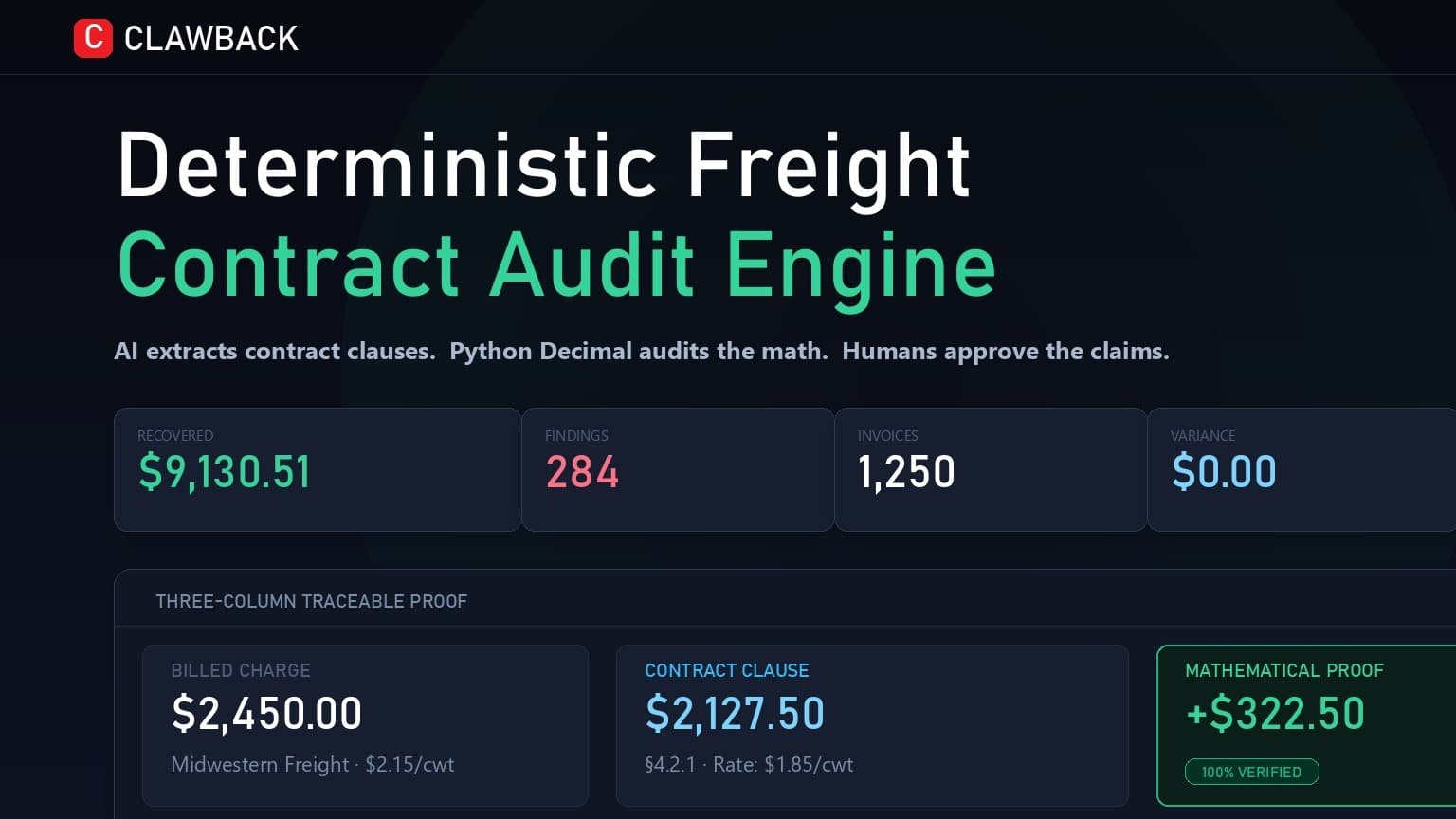
The Problem Shippers pay carrier invoices with thousands of charges, and nobody has time to check each one against the negotiated contract. Audit vendors report that freight audits recover about 3 to 7 percent of freight spend, and carriers often allow only a short dispute window, commonly around 15 days for parcel. Outsourced audit firms commonly take 20 to 50 percent of what they recover. These figures come from vendor sources and are indicative only. Why This is a Commerce Track Project Most commerce tools chase top-line revenue growth. Clawback protects margin from the cost side. In commercial logistics and supply chain operations, freight spend represents 8 to 15 percent of total cost of goods sold (COGS). A dollar recovered from an overcharge drops directly to pre-tax net margin. How AMD is Used Model & Host: The model that reads contracts and normalizes messy invoice charge descriptions is google/gemma-2-9b-it, hosted on AMD Developer Cloud / AMD Token Factory infrastructure (notebooks.amd.com). Replay Mode: When offline or if API quotas are exhausted, a deterministic replay mode serves recorded outputs from real AMD calls, visibly labeled with a persistent REPLAY badge. Workload Concurrency: Utilizes k=3 parallel self-consistency consensus extraction and batch charge-description normalization, fully utilizing AMD ROCm GPU concurrency. Measured Results (Synthetic Benchmark) Source: benchmark/results.json (Mode: replay / baseline; Run Date: October 16, 2026). Accuracy: Audit Recall: 100.00% (284 of 284 planted errors detected) Audit Precision: 100.00% (0 false positives) True Positives: 284 | False Positives: 0 | False Negatives: 0 Planted Ground Truth: $9,130.51 USD Recovered Overcharges: $9,130.51 USD Dollar Variance: $0.00 (0.00%) Note: These results prove the pipeline and deterministic arithmetic engine work as designed on synthetic benchmark data. They are not evidence of real-world carrier recovery rates.

NEXUS ONE — Multisectoral AI Platform

NEXUS ONE — Multisectoral AI Platform

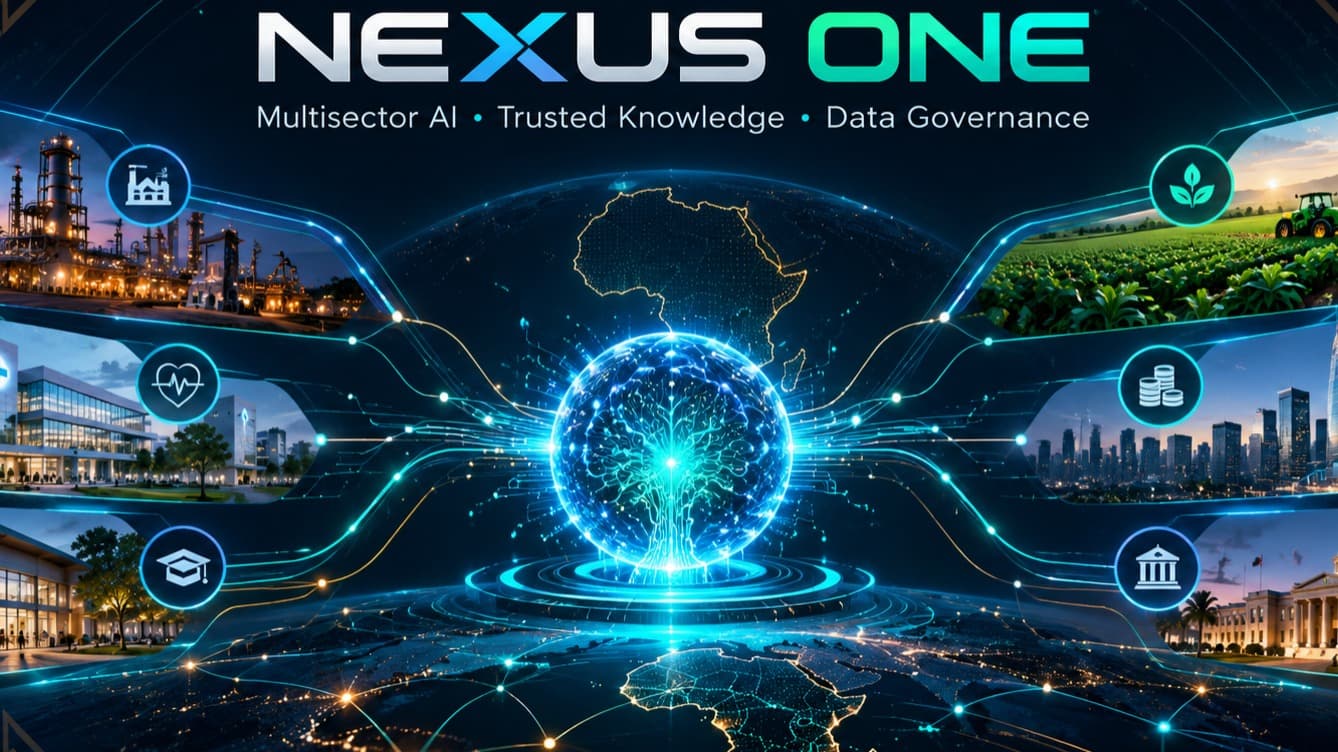
NEXUS ONE is a multisectoral AI platform designed to help organizations analyze documents, access reliable knowledge, and automate complex tasks through specialized AI agents. It combines Retrieval-Augmented Generation (RAG), document analysis, modular AI workflows, security, and data governance to provide context-grounded answers while supporting responsible data management. INDUXIA is the industrial intelligence module of NEXUS ONE. It focuses on equipment monitoring, anomaly detection, predictive maintenance, and industrial resilience. By combining technical documentation, maintenance manuals, operational data, and AI-assisted analysis, INDUXIA aims to help industrial operators identify potential problems earlier, improve maintenance decisions, and reduce operational disruptions. The platform is designed with a modular architecture that can evolve to support different sectors, including industry, healthcare, education, agriculture, finance, telecommunications, and public services. Each module can address specific needs while sharing a common foundation for AI orchestration, document retrieval, access control, and governance. Our long-term vision is to build a secure, adaptable, and scalable AI ecosystem developed with African needs in mind and designed for use in Africa and internationally. NEXUS ONE provides the multisectoral foundation, while INDUXIA demonstrates its practical value through industrial predictive intelligence. The project aims to make advanced AI more accessible, useful, and responsible for organizations of different sizes.

Culltron CivicOps

Culltron CivicOps

The problem. In a South African storm, municipal call centres flood. Reports arrive by phone, WhatsApp, email and walk-ins, and get re-typed, lost or duplicated. Residents never learn what happened, and control rooms cannot show who decided what. What CivicOps does. One front door: residents report by voice, chat, SMS, WhatsApp, web form or Open311 and get a reference number. On the live demo the resident agent is an ElevenLabs conversational agent using short-lived signed sessions. Bounded agents (Gemini 3.5 Flash-Lite, with a deterministic fallback) extract facts, triage, flag duplicates, recommend an eligible crew and draft resident updates, recording provider, model, confidence and reasoning. Agents cannot approve, assign or send anything: a dispatcher approves and assigns, and a supervisor names the incident commander and decides mutual aid. A live map shows aggregated operations only, with no person tracking. Multiple agencies share one incident and timeline. SOS needs a deliberate 3-second hold and never replaces 10111, 10177 or 112. Every action goes into an append-only SHA-256 hash-chained audit trail verifiable in the browser. Hard spend caps switch the demo to a labelled simulation. Honest scope. The demo uses synthetic data (EXPLICIT DEMO); email goes to an outbox only and field responses are simulated; Afrikaans and isiZulu translations await native review. An AMD Instinct/vLLM open-model path is implemented but was not run on AMD hardware for this event.

TrustForge — Evidence-Gated AI Software Factory

TrustForge — Evidence-Gated AI Software Factory

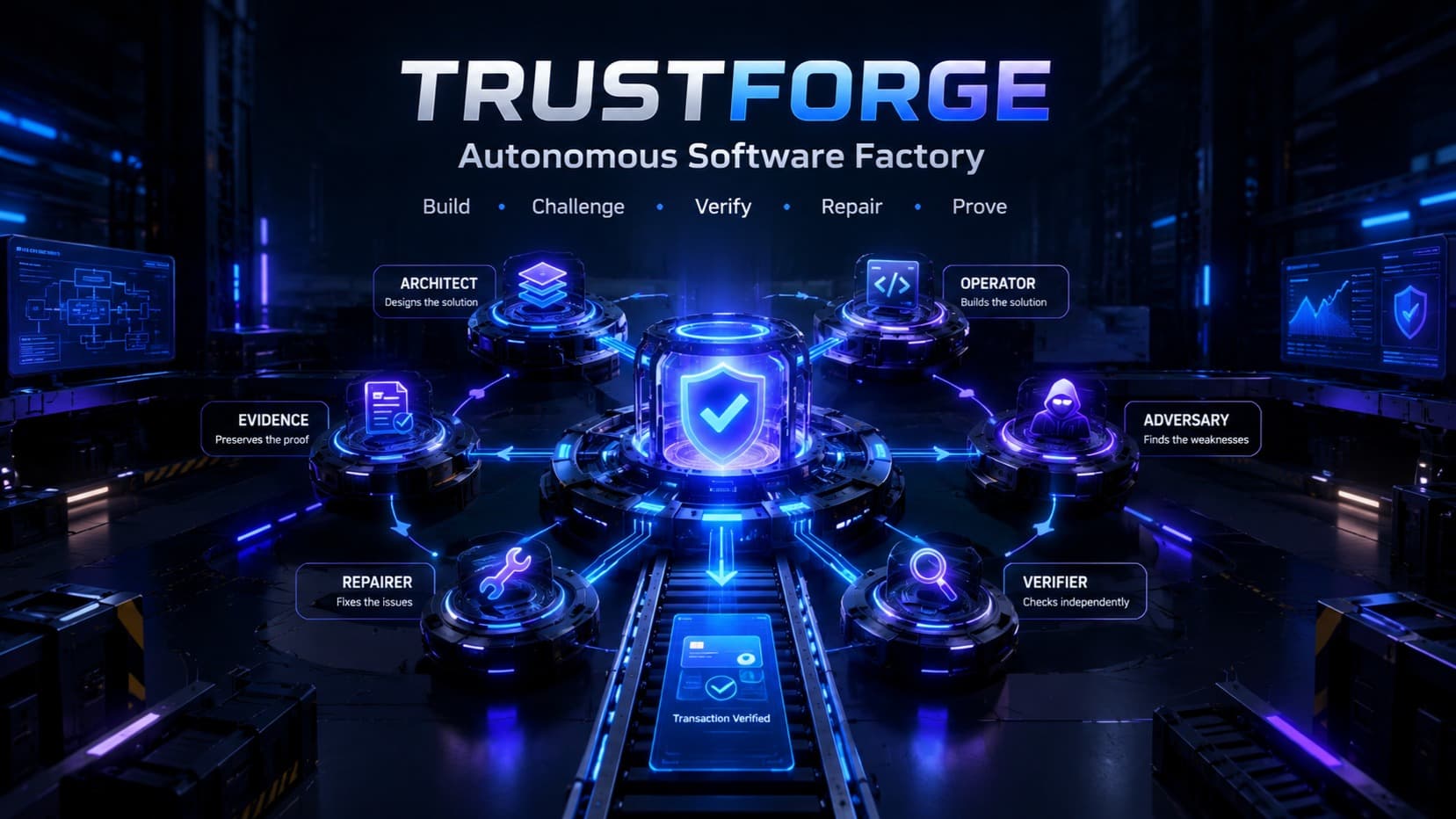
TrustForge is an autonomous software factory designed around one principle: code that works is not necessarily code that can be trusted. Instead of relying on a single AI coding agent to build software and declare it finished, TrustForge creates a complete engineering loop: Architect → Operator → Adversary → Verifier → Repairer → Verifier → Evidence Each seat has a bounded responsibility. The factory transforms requirements into explicit properties, generates adversarial scenarios, implements the required behavior, independently verifies the running system, repairs concrete failures and re-verifies the repaired revision before producing an evidence package. For the Pocketful track, TrustForge produced a self-contained Stage 1 wallet and payments service covering authentication, payments, requests, bill splitting, idempotent writes, atomic multi-item operations, exact integer money arithmetic, activity visibility and state export/import. The verification philosophy is simple: Requirement → Property → Scenario → Implementation → Execution → Observation → Verdict → Repair → Re-verification TrustForge does not treat “tests passed” as proof of universal correctness. Its evidence model explicitly distinguishes VERIFIED, FAILED, INCONCLUSIVE and BLOCKED states and preserves limitations and failure history. The recovered project records 147/147 shipped checks passing in the official isolated Pocketful Stage 1 harness, alongside independent HTTP verification and reproducible container instructions. The factory itself is designed to be reusable beyond Pocketful. Its mandates are domain-agnostic and can be applied to software, APIs, business automations, AI agents and AI-generated applications. TrustForge's goal is not simply to make AI build faster. It is to make AI-built software harder to trust blindly.

Generative AI Studio