Groq

Groq, Inc. is a company specializing in artificial intelligence (AI) hardware and software solutions. Founded in 2016 by ex-Google engineers, Groq focuses on delivering AI acceleration technologies to power next-generation applications across industries. With its deterministic approach to computation, Groq redefines performance and efficiency in AI inference tasks, providing scalable and developer-friendly solutions.

Headquartered in Mountain View, California, Groq operates globally, with additional offices in Canada, Europe, and other parts of the United States. Their solutions are tailored to meet the demands of enterprises seeking high-speed AI capabilities with a focus on reliability and cost efficiency.

General Information

AttributeDetails
AuthorJonathan Ross, CEO and Founder of Groq
CompanyGroq
Founded2016
DocumentationGroq Libraries
Github repositoryhttps://github.com/groq
Discordhttps://discord.com/invite/groq
technology TypeAI Accelerator Hardware and Software Solutions

Products and Services:

  • Language Processing Unit (LPU): Groq's LPU is architected from the ground up with a software-first design to meet the unique characteristics and needs of AI. It offers a deterministic execution model, eliminating traditional hardware bottlenecks and providing seamless scalability.

  • GroqCloud: A developer-centric platform that provides API access to Groq’s high-performance AI models. GroqCloud supports a range of applications, from vision and language processing to real-time inference tasks, delivering low-cost and high-quality results.

  • AI Models and API Access: Groq offers a range of AI models accessible via APIs, including vision models like Llama 3.2 11B Vision 8k and Llama 3.2 90B Vision 8k. These models are designed to provide high-quality, real-time inference for various applications.

How to Start Building with Groq

To begin leveraging Groq’s high-performance AI solutions, start by exploring their development environment. Developers can tap into GroqCloud for seamless API access to pre-trained models or optimize their own AI workloads using Groq's Language Processing Unit (LPU).

Visit Groq's GitHub repository to download SDKs, tools, and libraries required for your development.

Start building with Groq 👉 https://console.groq.com/login

Groq top builders

Explore the top contributors showcasing the highest number of Groq app submissions within our community.

Groq AI technology page Hackathon projects

Discover innovative solutions crafted with Groq, developed by our community members during our engaging hackathons.

Wasel

Wasel

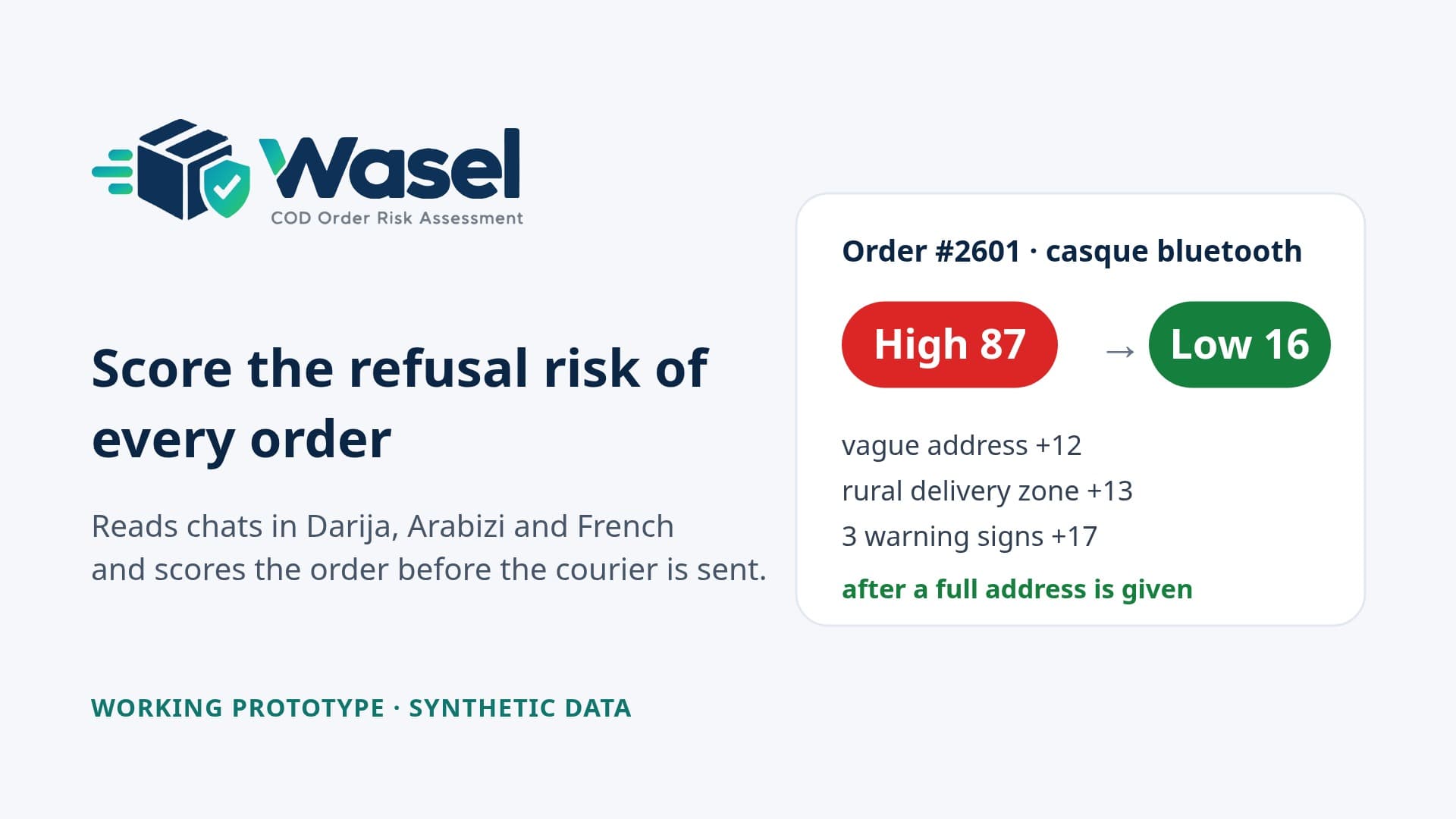
Sellers in Tunisia take orders in chat and are paid in cash on delivery. A refused parcel is a wasted courier trip. Customers write in Darija (Arabic script or Arabizi), French or a mix, and give addresses like "near the mosque". Wasel reads the conversation, extracts the order and scores the refusal risk from 0 to 100, with reasons quoted from the customer's own words. It drafts the one question that would lower the risk: confirm, complete the address, or pay first. When the customer answers, the order is rescored and the page shows which reasons changed. Order #2601 goes from High 87 to Low 16 once a full address arrives. A person approves what is sent. The language model never picks a number. It fills a 12-field schema, code checks every quote against the original text, and an XGBoost model plus the rules in config/scoring.yaml compute the score. Drafts come from approved templates; any model rewrite must pass a prefilter, a classifier and a judge. Injected text in a message is flagged. Business value: in a simulation on 2,001 held-out orders, confirmation and prepayment questions cut refusals from 30.0 % to 23.6 %, worth 464 TND per 1,000 orders (labels simulated, assumptions shown in the app). Tested on every change: 279 extraction cases, 165 outbound drafts, 32 injection attempts and 737 tests that run without keys. AMD: the model call goes through a configurable route: AMD Token Factory (Gemma-4-31B-IT) first, hosted Groq (gpt-oss-120b) as a fast backup, then rules. On 40 extraction cases, Token Factory recognised 92.5 % of orders against 87.5 % for Groq (one run, synthetic data). It takes 7 to 13 s per call, so the route allows 16 s before falling back. We make no claim about the GPU. The demo uses synthetic data. Open source under the MIT licence.

Factory Agent: AI Quality & Maintenance Assistant

Factory Agent: AI Quality & Maintenance Assistant

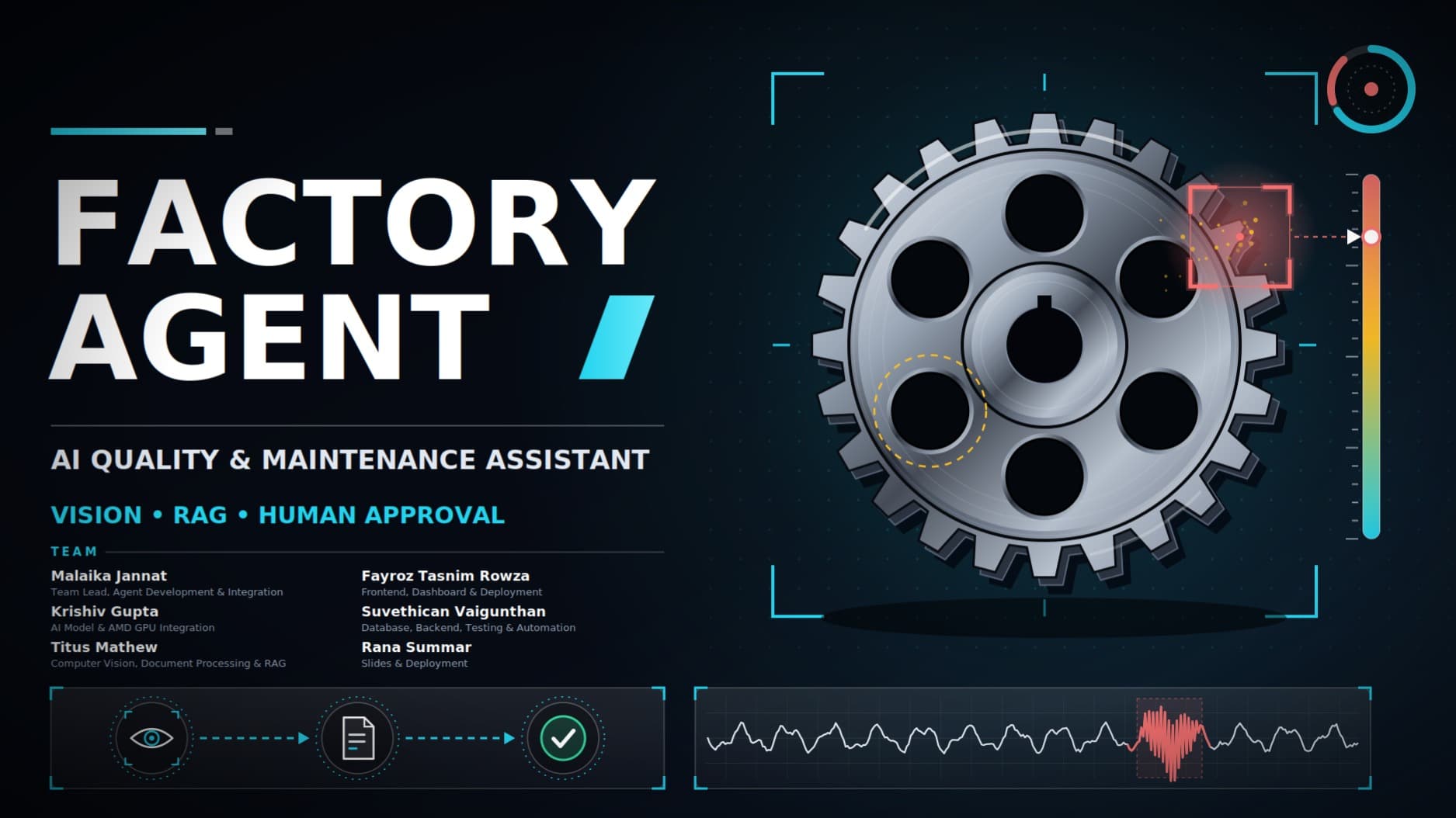
Factory Agent is an end-to-end AI quality inspection and industrial maintenance assistant designed for modern manufacturing environments. It addresses costly equipment downtime and the safety risks of unverified AI recommendations through multimodal defect detection, retrieval-augmented generation (RAG), evidence-grounded diagnosis, and human-in-the-loop governance. The system accepts machine-part photographs, sensor telemetry reports in CSV, JSON, or TXT formats, and technical inspection documents in TXT or PDF formats, including OCR-based text extraction. For visual inspection, Factory Agent combines an advisory local CNN with AMD Token Factory vision models, including Qwen3.8-Flash-Next and Gemma-4-31B-IT. It evaluates individual model predictions rather than averaging confidence scores, flagging low-confidence results and disagreements as UNVERIFIED for expert review. Its RAG pipeline retrieves relevant maintenance procedures from technical manuals. Primary and fallback language models, MiMo-V2.6-Flash and DeepSeek-V4-Flash, generate diagnostic explanations and repair recommendations grounded in retrieved evidence. The system validates recommendations against source manual text and provides citations identifying relevant manuals and pages where available. A human-in-the-loop interface enables plant managers to review predictions, examine supporting evidence, and approve or reject proposed maintenance actions. Only approved cases proceed to Evolus automation workflows for maintenance work-order generation. Built with Next.js, React, TypeScript, FastAPI, PyTorch, and Docker, Factory Agent supports cloud integrations and an offline mock mode for demonstrations and development without API keys. By combining automation, traceable evidence, and human oversight, Factory Agent aims to make industrial AI safer, more transparent, auditable, and practical.

AnalystOS — Your AI-Powered Business Analyst

AnalystOS — Your AI-Powered Business Analyst

AnalystOS — From Questions to Clarity Businesses have plenty of data, but finding meaningful answers is still difficult. Dashboards show what is happening, yet understanding why often requires hours of analysis, technical expertise, and investigation across multiple data sources. AnalystOS is your AI-powered business analyst, helping turn business questions into evidence-backed insights. Ask questions in plain language, such as “Why did sales decline this month?” AnalystOS helps investigate the question, examine relevant data, explore contributing factors, and bring the findings together into an understandable outcome. More than a chatbot, AnalystOS provides a workspace for ongoing investigations. Each Analysis preserves relevant discoveries, assumptions, decisions, unresolved questions, and analytical assets, allowing users to revisit previous work and build on it through follow-up conversations. Key capabilities: • Investigate business questions beyond a single response. • Explore the factors behind sales, customer, product, and marketing trends. • Connect findings to supporting evidence, queries, and results. • Preserve analytical context across conversations. • Create reusable assets, including findings, tables, charts, and queries. • Keep people in control of conclusions and business decisions. Designed initially for commerce analytics, AnalystOS helps teams explore business performance without requiring every user to write queries or understand complex database structures. Our vision is to make business intelligence an ongoing process of asking better questions, investigating evidence, and building lasting knowledge. AnalystOS brings this process into one intelligent workspace, helping businesses spend less effort finding answers and more effort understanding what those answers mean.