MongoDB

Get the latest and greatest with MongoDB 6.0! Build faster and smarter with a developer data platform built on the leading modern database. Whether you’re tackling transactional, search, analytics, or mobile use cases, MongoDB has you covered. Plus, enjoy a common query interface and a data model that developers love.

General
PlatformMongoDB
Repositoryhttps://github.com/mongodb/mongo
TypeNoSQL Database

Key features

Build Faster: Ship and iterate 3–5x faster using MongoDB’s document data model. Enjoy a unified query interface for any use case.

Scale Further: Whether it’s your first customer or 20 million users, meet your performance SLAs in any environment.

Safety first: Ensure high availability, protect data integrity, and meet security and compliance standards for mission-critical workloads.

Fully Managed in the Cloud: Start in seconds and scale to millions with MongoDB Atlas, our cloud services. Explore a multi-cloud developer data platform for various use cases, from transactional to analytical.

Mobile Real-Time Data at the Edge: Launch secure mobile apps with native, edge-to-cloud sync and automatic conflict resolution.

Self-Managed Option: Run MongoDB anywhere, from your laptop to your data center.

Community Edition: Our distributed document database is where it all began. Free forever with seamless migration to Atlas.

Enterprise Advanced: For robust features and support, consider the enterprise version.

Built by Developers, for Developers: MongoDB’s document data model maps to how developers think and code.

What You Can Do with MongoDB

It’s a flexible document data model that lets you ship and iterate faster. Enjoy a unified query interface for all use cases. Whether it’s your first customer or 20 million users worldwide, MongoDB ensures performance SLAs in any environment. Easily ensure high availability, protect data integrity, and meet security and compliance standards for your mission-critical workloads. Plus, MongoDB Atlas provides fully managed cloud services, and you can run it anywhere, from your laptop to your data center.

AI Tutorials


MongoDB top builders

Explore the top contributors showcasing the highest number of MongoDB app submissions within our community.

MongoDB AI technology page Hackathon projects

Discover innovative solutions crafted with MongoDB, developed by our community members during our engaging hackathons.

LifeOS AI — Personal Digital Twin

LifeOS AI — Personal Digital Twin

LifeOS AI is an intelligent personal digital twin designed to transform how people manage their daily lives using artificial intelligence. It learns user-approved preferences and remembers important information while helping users organize tasks and achieve long-term goals. Unlike traditional AI assistants LifeOS AI maintains personalized context to deliver relevant recommendations across conversations. The platform combines persistent memory with AI agents for task planning and knowledge retrieval. Its Personal Memory Engine stores approved information while Retrieval-Augmented Generation (RAG) retrieves relevant context from personal documents. The Intelligent Planning Agent converts goals into actionable steps and prioritizes tasks based on deadlines and preferences. A Goal Tracking Agent monitors progress and suggests adjustments when plans change. LifeOS AI uses large language models to understand natural language and generate contextual responses. Its agent orchestration system coordinates specialized agents to research information and execute approved actions through connected tools. The platform aims to integrate calendars and productivity applications for seamless task management. The project explores AMD GPU acceleration using compatible open-weight models and ROCm with PyTorch where supported. Performance will be evaluated through response latency and task completion rates alongside retrieval quality and resource utilization. Privacy remains a core principle. Users can inspect and delete stored memories and control connected services. The system will distinguish verified information from AI-generated suggestions and request approval before consequential actions. Built with React and Python or Node.js alongside MongoDB and vector search technologies LifeOS AI aims to create a personalized intelligence layer that makes everyday decisions easier and productivity smarter. LifeOS AI — Think Ahead. Act Smarter. Live Better.

AptStock: AMD-Accelerated Inventory Intelligence

AptStock: AMD-Accelerated Inventory Intelligence

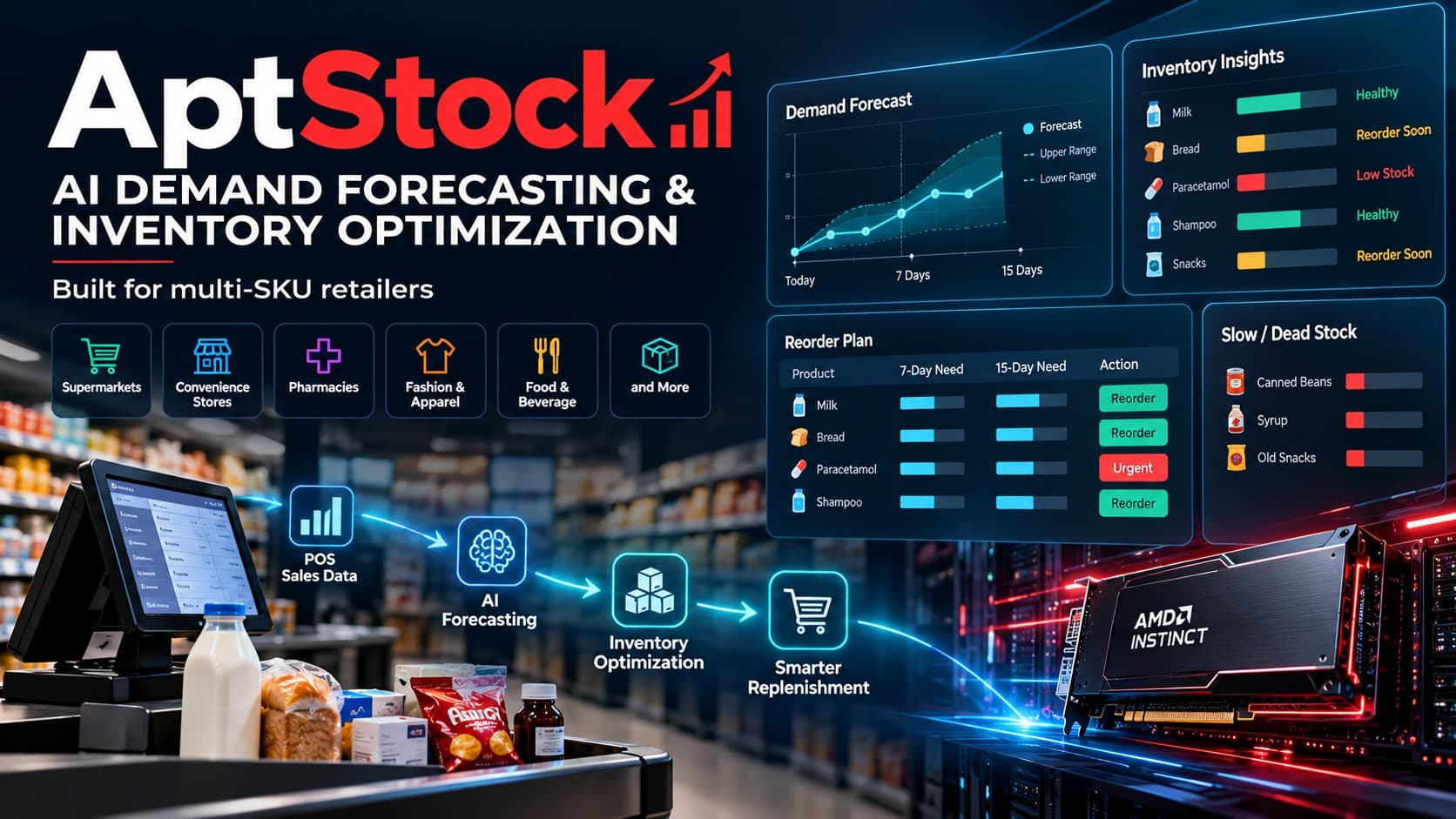
AptStock — AI Demand Forecasting & Inventory Optimization on AMD AptStock transforms point-of-sale (POS) history into demand forecasts and inventory decisions for Multi-SKU stores—even when current-stock data is unavailable. Multi-SKU stores can upload simple CSV/Excel sales data to explore product-level forecasts, forecast ranges, stockout risks, safety-stock estimates, reorder triggers, and recommended stock for 7-day and 15-day planning. AptStock prioritizes replenishment, identifies fast-moving products and slow/dead stock, estimates remaining stock coverage when inventory data is available, and generates purchase lists and exportable reports. Its voice assistant helps retailers identify products needing attention and decide what to reorder first. For AMD Developer Hackathon: ACT III, AptStock uses PyTorch and AMD ROCm to run batched inventory calculations on AMD Instinct MI300X hardware. The workload includes demand statistics, safety stock, 7-day and 15-day stock recommendations, and reorder points. Input validation, CPU-reference comparisons, and shadow-mode execution help verify numerical consistency while preserving the CPU-authoritative recommendation path. In the recorded sample-route integration test, CPU and AMD inventory outputs matched for 5,000 SKUs. An end-to-end benchmark tested 500, 2,000, and 5,000 SKUs using 180 days of synthetic demand history. Timing included data transfer, GPU computation, and result transfer. All nine inventory outputs passed numerical-tolerance checks. The October 18, 2026 report recorded a 1.446× CPU-to-AMD speedup at 5,000 SKUs. This result applies to the tested configuration, not every workload or the complete forecasting pipeline. AptStock combines practical retail decisions, explainable inventory mathematics, conversational insights, AMD execution, CPU/GPU validation, and transparent benchmarking. Next steps include broader retailer-data validation and measurement of forecast quality and operational outcomes.

Referto: medical report, explained in plain words

Referto: medical report, explained in plain words

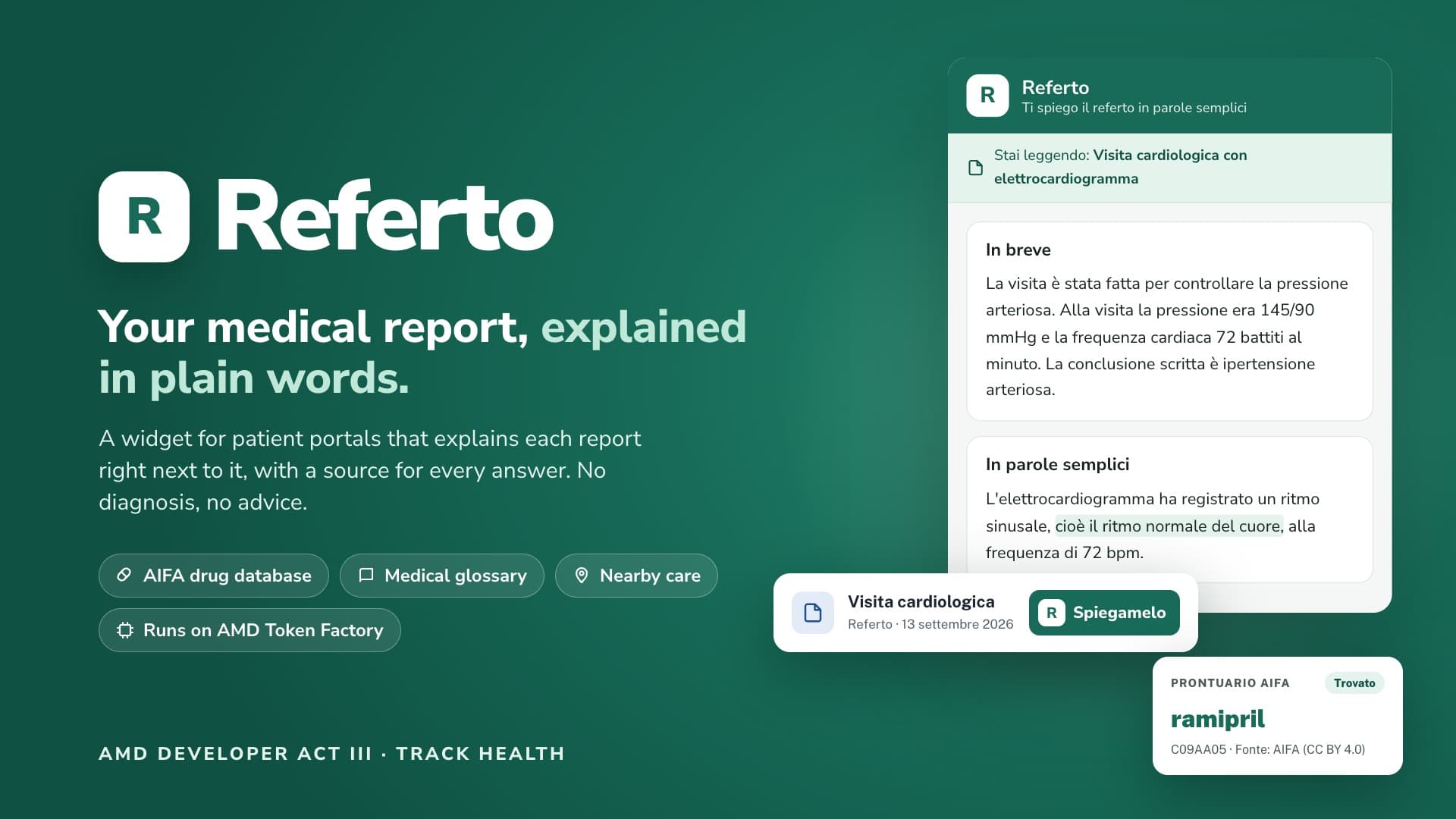
THE PROBLEM In Italy, every medical report reaches the patient's electronic health record within five days, often weeks before they can talk to a doctor. 58% of Italians struggle to understand health information (HLS19). So they search online, paste the report into a chatbot with no sources, or call a family doctor who is already overloaded: Italy is short of 5,700 GPs. The country invested €1.38 billion in the health record, yet only one patient in four opens it when a new report arrives. THE SOLUTION Referto is a widget next to the report, inside a clinic's patient portal. One click on "Explain this to me" and the patient gets: - a summary and a plain-language explanation of the report; - the doctor's instructions in a separate box, linked to the document; - answers to their own questions from a medical glossary, with the source; - every medicine the doctor wrote, matched to the official AIFA database, with the leaflet and answers that cite its section; - the nearest facilities for the report's specialty, on a map from open data. The agent runs on an open model (DeepSeek V4 Flash) on AMD Token Factory. TRUST BY DESIGN Referto never diagnoses, never suggests treatments and never adds medicines: it explains only what is written. The model rewrites; sources decide what is true. Code adds guardrails: sources a tool did not return are removed, words not in the report get a fixed answer, and medicines are matched by code, not by the model. The last word always belongs to the doctor. BUSINESS VALUE Every report understood is one less call to the doctor and one more reason to open the health record. Referto enters through the portals that already deliver reports: GP practices, then private labs, then regional health records. Italian digital health is worth €2.7 billion a year; with the European Health Data Space, the need reaches 450 million Europeans.