Assistants API

OpenAI's Assistants API simplifies AI integration for developers, eliminating the need for managing conversation histories and providing access to tools like Code Interpreter and Retrieval. The API also allows developers to integrate their own tools, making it a versatile platform for AI assistant development.

General
AuthorOpenAI
DocumentationLink
TypeAI Assistant

Model Overview

The Assistants API enables developers to create AI assistants using OpenAI models and tools. It supports various functionalities such as managing conversation threads, triggering responses, and integrating customized tools.

Assistants API Tutorials


Technology Resources

The Assistants API allows developers to construct AI assistants within their applications. An assistant can leverage models, tools, and knowledge to respond to user queries effectively. Presently supporting Code Interpreter, Retrieval, and Function calling, the API aims to introduce more tools developed by OpenAI while also allowing user-provided tools on the platform.

To explore its capabilities, developers can use the Assistants Playground or follow the integration guide in the official documentation. The integration process involves defining an Assistant, enabling tools, managing conversation threads, and triggering responses.

Assistants API top builders

Explore the top contributors showcasing the highest number of Assistants API app submissions within our community.

OpenAI Assistants API AI technology Hackathon projects

Discover innovative solutions crafted with Assistants API, developed by our community members during our engaging hackathons.

Jarvis

Jarvis

It is a very powerful ai chatbot which can run using your hand movements and run on various environments to perform your various tasks visually using 3D visualisation and remind you of anything anytime just using commands and many more to come.JARVIS is not just an AI assistant; it is an ambitious step toward building a futuristic digital intelligence inspired by the possibilities of Tony Stark’s legendary technology. Designed as an expanding ecosystem of intelligent environments, JARVIS combines conversational AI, futuristic interfaces, visual intelligence, scientific simulations, and centralized command capabilities into one powerful web-based platform. Its six environments—Main JARVIS, Velve, Terranexus, Command Centre, Vision Intelligence, and Ultron—represent different dimensions of an interconnected digital universe. From exploring scientific experiments and mechanical simulations to visual intelligence and advanced system interaction, every environment expands what a personal AI ecosystem can become. JARVIS aims to transform the way humans interact with technology, bringing multiple intelligent capabilities together through a unified interface. Its long-term vision reaches beyond answering questions toward helping users interact with digital tools, navigate complex information, and manage technological workflows. Built with the ambition to evolve continuously, JARVIS represents a bold vision of a world where AI is not merely something you talk to—it becomes the intelligent interface connecting you to your digital universe. JARVIS: One Intelligence. Multiple Environments. An Entire Digital Universe at Your Command.

ClearPath — Discharge Coordination

ClearPath — Discharge Coordination

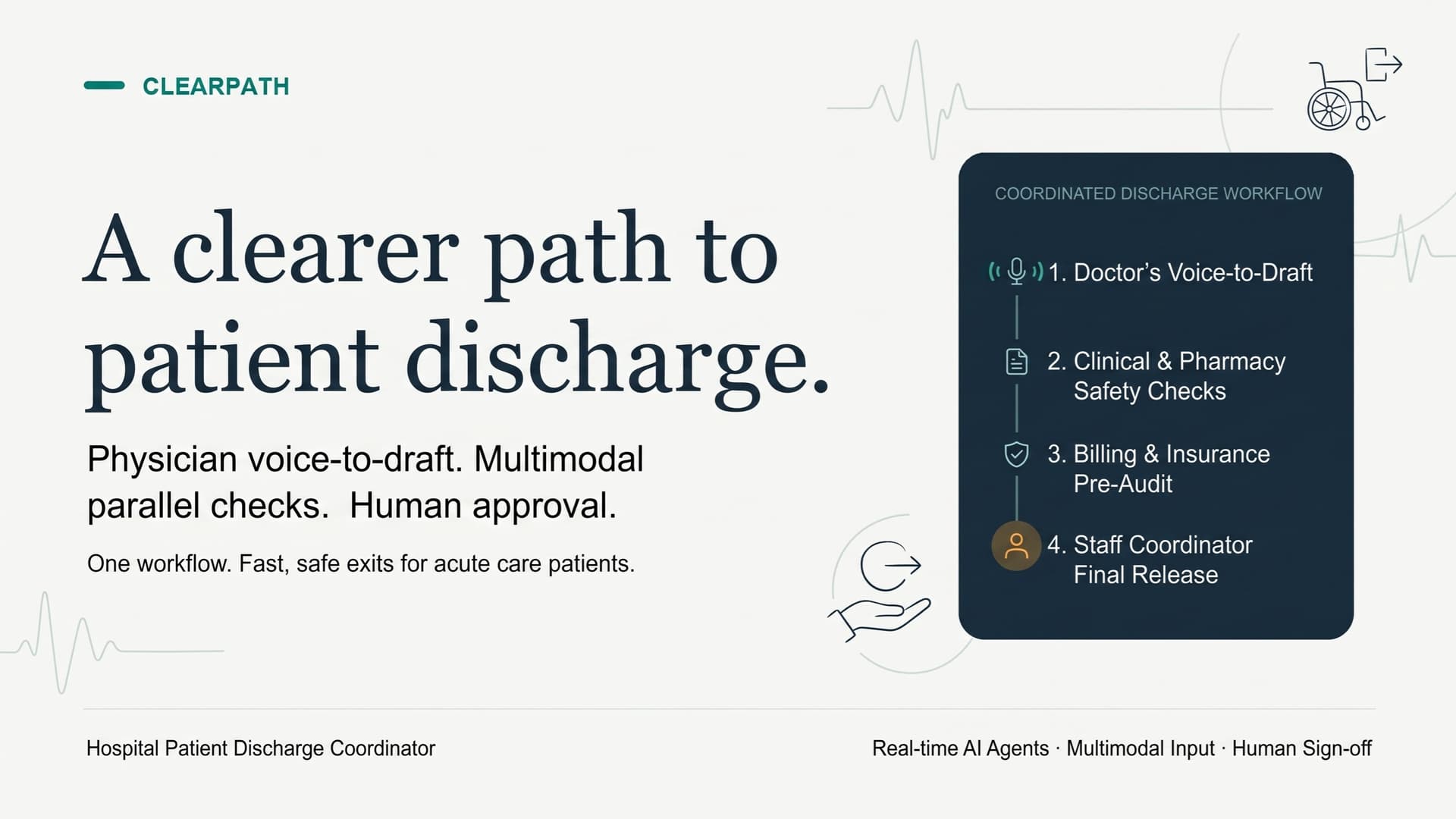
Hospital discharge spans clinical documentation, medication review, and billing. Each participant needs to know which information has been reviewed and whether a finding still applies after a change. ClearPath demonstrates a shared discharge workflow for a hospital discharge coordinator. A clinician's note and proposed medicines are combined with a synthetic patient record. DeepSeek-V4-Flash, accessed through the configured AMD Radeon API, prepares a summary and review notes. Doctor approval is attached to a specific revision. Once approved, pharmacy and billing workers run concurrently through Model Context Protocol (MCP) tools and return structured findings. The demonstration includes an exact medication/allergy matching rule and a comparison of recorded consumable usage with billed quantities. Results distinguish a completed check with findings from a check that failed to run. An edit invalidates approval and existing findings, preventing results from an earlier revision from being silently reused. SQLite preserves workflow snapshots across application restarts. The implementation uses Python, FastAPI, Pydantic, FastMCP, asyncio, and SQLite. The core workflow can be exercised locally through the API and command-line examples; the browser interface provides a visual demonstration of the same workflow. This is a synthetic-data prototype. The AMD inference path has returned a valid draft in a real synthetic-input run. The pharmacy and billing checks remain deterministic. No clinical effectiveness or hospital-outcome claims are made. The pharmacy rule is deliberately narrow, not a clinical medication safety system. The workflow supports review; it does not authorize discharge. Real EHR connections, authenticated clinical approvals, insurer integrations, and production clinical validation remain future work.

WebInfo: Watch an AI Agent Find the Answer for You

WebInfo: Watch an AI Agent Find the Answer for You

WebInfo is an AI agent that does web research for you. Ask a question in plain English and it searches the web, opens the real websites in its own browser, reads them, pulls out the exact fact and highlights the sentence it came from on the real page. You watch it work live, with a breathing gaming-style cursor moving over the sites and a step-by-step agent log. Every answer comes with its source link and a word-for-word quote, and if the fact isn’t there it says so instead of guessing. How it works: FastAPI streams each step to the browser. Tavily finds the pages and their text in one search, headless Chromium (Playwright) opens them, Gemini Flash-Lite extracts the answer as JSON with verbatim quotes, and Postgres caches answers and tracks API usage. It runs in Docker on a free Google Cloud e2-micro VM, deployed from GitHub. What we optimized: answers dropped from 34 s to as fast as 5 s, because Gemini reads the search text while the browser opens the page in parallel. Results are ranked by relevance to the question, and model numbers and years must match. Each new question costs 1 search credit and 1–2 Gemini calls, and repeat questions cost zero. Hard caps keep it on free tiers, so it runs for $0. It blocks private addresses, respects robots.txt and treats page text as untrusted. Example: asked for the AMD Developer Hackathon ACT III prize pool on lablab.ai, it opened lablab.ai, answered $17,000+ and highlighted the proof on the page.