GPT 4o

Overview

The GPT-4o family, introduced in mid-2024, is OpenAI’s advanced multimodal series designed for high-efficiency and interactive applications. Built on the foundation of the GPT-4 architecture, the 4o models process text, images, and audio, supporting highly responsive and nuanced interactions.

Key Features

  1. Multimodal Capabilities – Handles text, images, and voice, making it versatile for applications across domains such as customer support, education, and content creation.
  2. Real-Time Voice Interaction – Responds to audio inputs with minimal latency, allowing for natural, conversational exchanges.
  3. Multilingual Support – Supports over 50 languages, enabling global accessibility and adaptability.
  4. Cost-Effectiveness – The model runs twice as fast as GPT-4 Turbo while being 50% more cost-effective, making it attractive for businesses with high interaction volumes.

Variations

  • GPT-4o Base – Designed for general multimodal applications, optimized for balanced performance across text, image, and audio inputs.
  • GPT-4o Mini – A smaller, cost-effective version for high-demand, lower-cost applications, ideal for scaling large deployments.

Applications

  • Customer Support – Enables real-time support across text, audio, and images, enhancing user experience.
  • Content Creation and Translation – Automates content generation and accurate translation across multiple languages.
  • Accessibility Solutions – Enhances accessibility tools for people with disabilities, using voice and visual processing.

Getting Started with GPT-4o

While a dedicated tech page is forthcoming, OpenAI offers APIs for developers to experiment with the GPT-4o family in various interactive and multimodal applications.

GPT 4o top builders

Explore the top contributors showcasing the highest number of GPT 4o app submissions within our community.

OpenAI GPT 4o AI technology Hackathon projects

Discover innovative solutions crafted with GPT 4o, developed by our community members during our engaging hackathons.

Agent_Trap_Evals

Agent_Trap_Evals

The problem: agents rarely fail hard questions. They fail chores. They report "backup verified" because the log says success, while the archive is truncated. These false claims slip out during routine work, and a real shell makes them dangerous. What Receipts does: you give it a real task, like checking a backup or triaging a failing build. A control layer plans the work and runs every action in an isolated Vultr sandbox [gVisor pods on VKE]. The sandbox has no secrets, has time and memory caps, and is destroyed after each task. Every command's output, exit code, and files become a receipt. Before any claim reaches you, a verifier checks it against those receipts: did the agent check the layer that matters, or just the easy one? An unsupported claim is blocked and sent back to be verified, or reported as unverified. You get the answer together with its proof. Containment: [demo moment, e.g. the agent runs rm -rf / and the sandbox absorbs it; the host is untouched]. Measured: we score Receipts with agent-trap-evals, an open-source trap set we built before the hackathon from real agent incidents. Verifier off vs. on: [X/Y vs. X/Y caught], [n] false alarms on honest controls. For: platform and DevOps teams putting agents on operational work, where a confident false "done" costs more than a slow answer. Sandboxes like E2B contain actions but don't check claims. Eval tools score offline but don't stop a bad claim at runtime. Receipts does both, live. [Business model; next steps.] All LLM calls use Vultr Serverless Inference.

AnalystOS — Your AI-Powered Business Analyst

AnalystOS — Your AI-Powered Business Analyst

AnalystOS — From Questions to Clarity Businesses have plenty of data, but finding meaningful answers is still difficult. Dashboards show what is happening, yet understanding why often requires hours of analysis, technical expertise, and investigation across multiple data sources. AnalystOS is your AI-powered business analyst, helping turn business questions into evidence-backed insights. Ask questions in plain language, such as “Why did sales decline this month?” AnalystOS helps investigate the question, examine relevant data, explore contributing factors, and bring the findings together into an understandable outcome. More than a chatbot, AnalystOS provides a workspace for ongoing investigations. Each Analysis preserves relevant discoveries, assumptions, decisions, unresolved questions, and analytical assets, allowing users to revisit previous work and build on it through follow-up conversations. Key capabilities: • Investigate business questions beyond a single response. • Explore the factors behind sales, customer, product, and marketing trends. • Connect findings to supporting evidence, queries, and results. • Preserve analytical context across conversations. • Create reusable assets, including findings, tables, charts, and queries. • Keep people in control of conclusions and business decisions. Designed initially for commerce analytics, AnalystOS helps teams explore business performance without requiring every user to write queries or understand complex database structures. Our vision is to make business intelligence an ongoing process of asking better questions, investigating evidence, and building lasting knowledge. AnalystOS brings this process into one intelligent workspace, helping businesses spend less effort finding answers and more effort understanding what those answers mean.

VoiceEstate AI for Real Estate Lead Qualification

VoiceEstate AI for Real Estate Lead Qualification

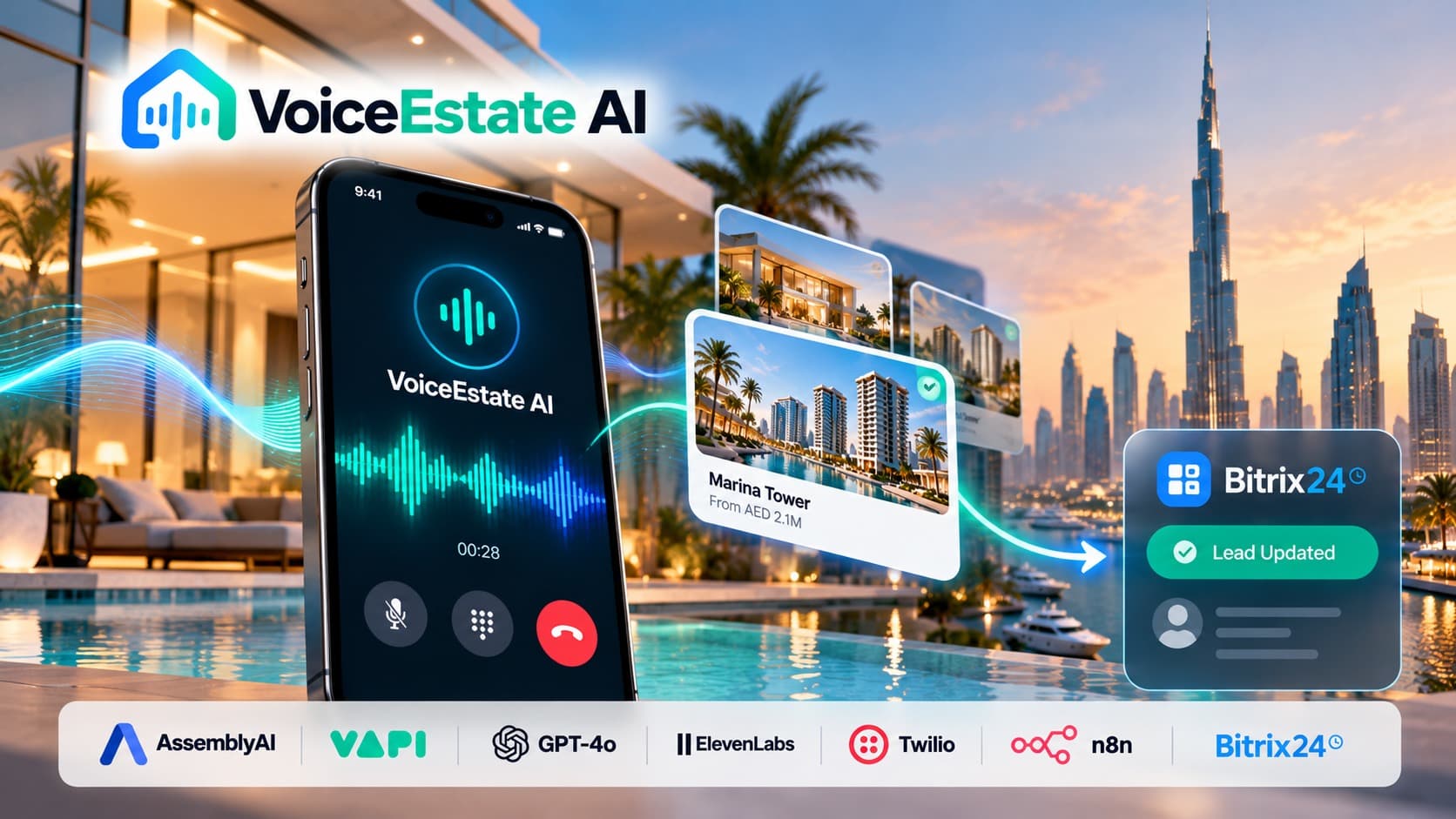
VoiceEstate AI is an AI voice agent built for Dubai real estate lead qualification, property discovery, and automated follow-up. When a new lead is assigned to the AI, it can automatically initiate an outbound phone call and have a natural conversation. The AI qualifies leads around investment vs. end-use, budget, preferred area, lifestyle, property type, bedrooms, project interest, and buying timeline. Instead of simply collecting information, it can use the lead's requirements to search Dubai off-plan property data of 2.5k+ records in real time and identify relevant projects. The AI can discuss matched projects using factual property information rather than inventing prices, features, or project details. After the conversation, Bitrix24 is updated with the lead's qualification data, call outcome, summary, and conversation context, giving the sales team useful AI-generated memory. Different outcomes are handled automatically, including qualified leads, callbacks, no-answer cases, not-interested leads, job enquiries, wrong numbers, and unreachable leads. Follow-up workflows can continue the conversation through scheduled AI call attempts and follow-up, reducing the amount of manual work required from sales teams. Qualified or interested leads can be moved toward a human sales consultant for the next stage of the sales process. AssemblyAI Universal 3.5 Pro powers real-time speech transcription, automatic language detection, and intelligent turn-taking inside the Vapi voice pipeline. GPT-4o handles conversation intelligence, ElevenLabs provides natural voice generation, Vapi manages the voice interaction, and Twilio handles phone connectivity. n8n orchestrates the automation while Bitrix24 remains the CRM and system memory for the lead lifecycle. The demo shows the complete journey: lead → AI voice conversation → qualification → property matching → CRM update → follow-up → human handoff.

VoiceAI The Real-Time Voice Topic Companion

VoiceAI The Real-Time Voice Topic Companion

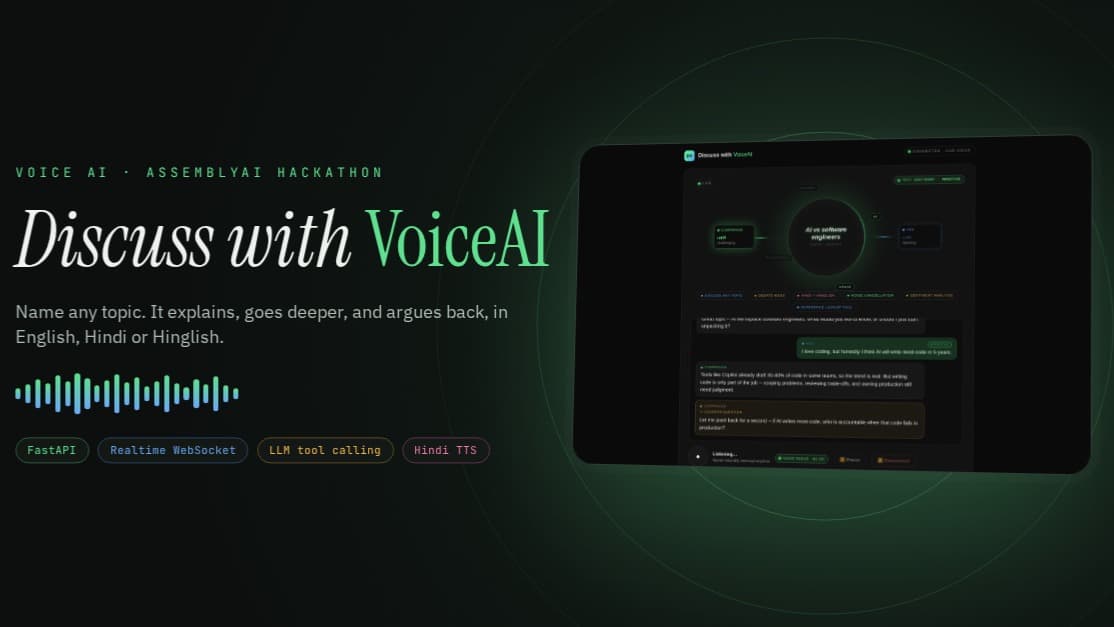
Discuss with VoiceAI is a voice-first AI Topic Companion designed for natural, open-ended conversations around any subject. Instead of following a fixed script or acting as a simple speech-to-text chatbot, the system lets users choose any topic and explore it conversationally through voice. The agent can answer questions, simplify complex concepts, go deeper when the user wants expert-level detail, and introduce concise counter-questions or alternative viewpoints to make the discussion more intellectually engaging. The user remains in control of the conversation and can change topics, ask follow-up questions, request examples, challenge the AI, or ask it to argue the other side. The system uses AssemblyAI's real-time Voice Agent API for streaming voice interaction, WebSocket-based communication, speech recognition, spoken responses, turn-taking and interruption handling. A FastAPI backend securely mints short-lived browser tokens so the long-lived API key never reaches the client. The architecture also includes live web search through Exa when the agent needs current information, allowing time-sensitive questions to be answered using fresh sources. A separate asynchronous sentiment layer analyzes finalized user transcript turns through the AssemblyAI LLM Gateway without blocking the voice response. The application supports both real voice interaction and an offline/mock text mode, making the complete conversational experience testable even without a live voice session. The frontend also provides real-time transcript state, audio-reactive visualization, conversation state indicators, and sentiment feedback. The project focuses on making voice interaction feel like a genuine discussion rather than a traditional chatbot: low-friction voice input, adaptive responses, conversational context, interruption support, current-information retrieval, and an architecture that keeps sensitive API credentials on the server.

Medinova: Multilingual Voice AI Clinical Triage

Medinova: Multilingual Voice AI Clinical Triage

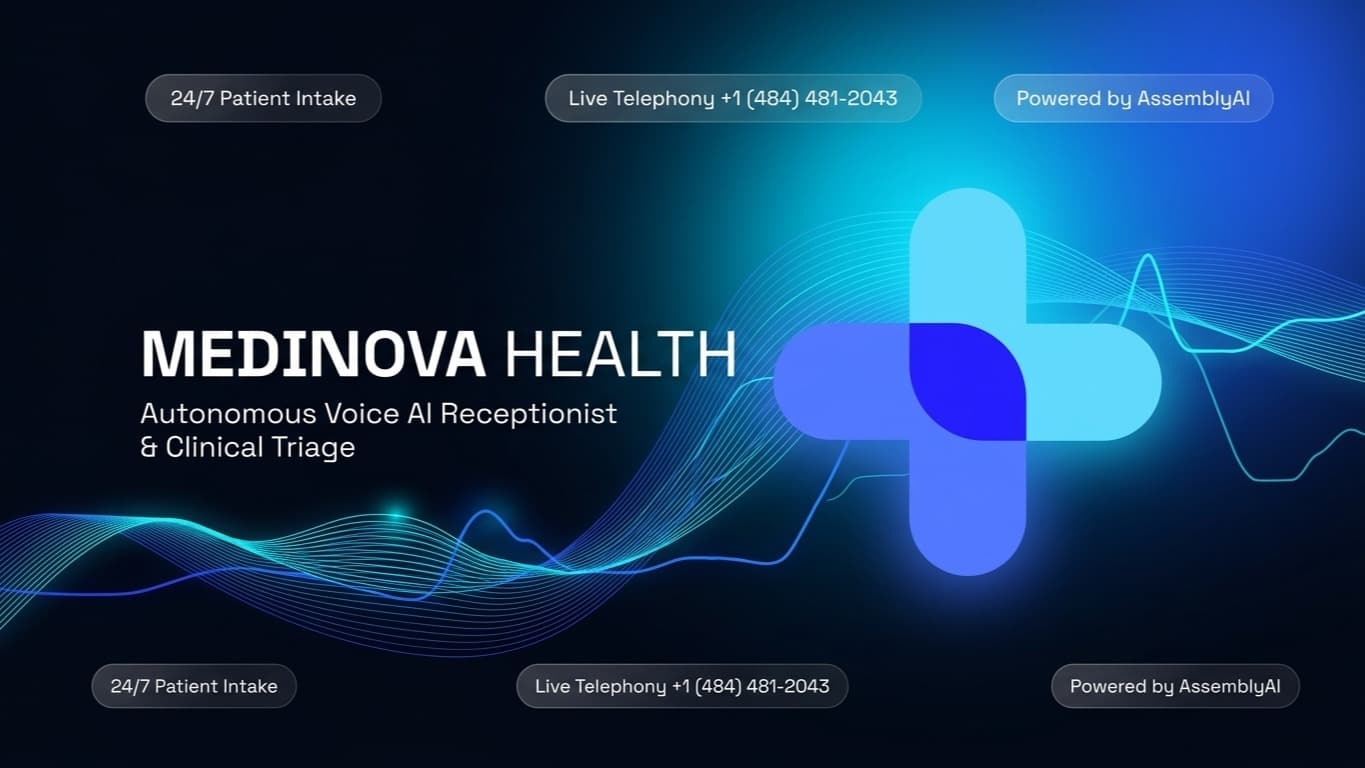
Medinova is an enterprise AI healthcare platform that automates patient phone intake, clinical triage, department routing, and appointment scheduling. By replacing legacy front-desk phone bottlenecks with an ultra-low latency conversational AI receptionist, Medinova ensures no patient call goes unanswered. Key Capabilities: 1. Multilingual Audio Intake powered by AssemblyAI: Powered by AssemblyAI Universal 3.5 Pro streaming speech-to-text, Medinova accurately transcribes callers speaking in any language—including Spanish, French, German, and Urdu—with medical-grade transcription accuracy in real time, responding in clear English and logging caller language for physicians. 2. Caller Memory & Returning Patient Continuity: Recognizes returning callers via SIP telephony or WebRTC, instantly retrieving past visit history, chief complaints, and pending appointments so patients never have to repeat themselves. 3. Clinical Safeguards & Emergency Escalation: Maintains strict healthcare boundaries without offering unauthorized medical diagnoses or prescriptions. If critical warning signs (e.g., chest pain, stroke symptoms) are detected, the agent immediately instructs the caller to dial 911. 4. Post-Call Triage & Healthcare Dashboard: Every call is asynchronously analyzed into 12 structured clinical data points, urgency ratings (URGENT, HIGH, MEDIUM, LOW), and department assignment (Cardiology, Pediatrics, General Medicine, etc.), writing directly to MongoDB Atlas and updating the Next.js clinical dashboard in real time. Live Inbound Telephony: +1 (484) 481-2043 Web Portal: medinova-assemblyai.vercel.app

RepoPilot : Agentic AI Onboarding

RepoPilot : Agentic AI Onboarding

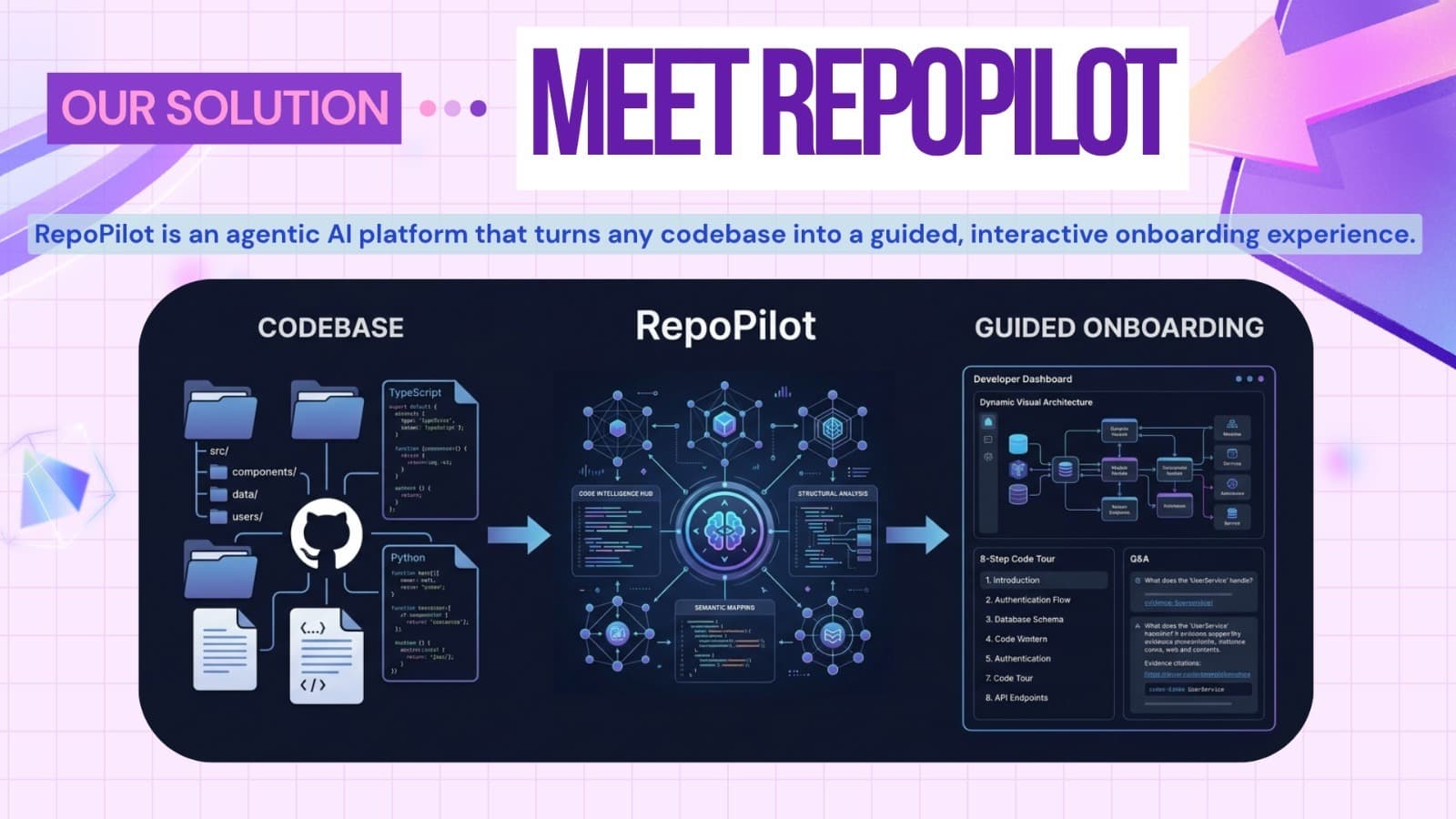
Every time a new developer joins a team or contributes to an open-source project, they face the same expensive barrier: context acquisition. Understanding a complex codebase—its architecture, business logic, entry points, and hidden invariants—typically takes weeks of manual exploration, outdated documentation reading, and interrupting senior engineers. This "week-one tax" costs companies thousands of dollars in lost productivity and delays critical feature delivery. Existing tools (static linters, basic README generators, or generic chatbots) fail because they lack full-repository context and cannot provide evidence-backed guidance tied to specific lines of code. The Solution: RepoPilot RepoPilot is an agentic AI platform that ingests any GitHub repository and autonomously produces a personalized, interactive, and evidence-backed onboarding experience in minutes. By leveraging IBM Bob 2.0 as its core reasoning engine, RepoPilot doesn't just summarize code—it understands it. It acts as an expert senior engineer pair-programming with the new hire, guiding them through the codebase via an interactive 8-Step Code Tour, grounded Q&A, and dynamic Architecture Visualization. How It Works (The Agentic Workflow) Ingest & Parse: The user pastes a GitHub URL. RepoPilot clones the repo, uses Tree-sitter to parse ASTs across Python/TypeScript/JavaScript, and chunks the code semantically. Parallel Agent Analysis (IBM Bob 2.0): Two specialized Bob subagents run in parallel: Architecture Agent: Maps modules, entry points, and data flow. Business Logic Agent: Identifies domain concepts, invariants, and state transitions. Synthesis & Narration: Findings are merged, ranked by conceptual dependency (not file hierarchy), and narrated by Bob into human-readable explanations. Interactive Delivery: The frontend renders a live Code Tour Viewer (with syntax highlighting and keyboard navigation) and a Grounded Q&A Panel where every answer cites exact file:start-end line ranges. Key Features & Innovation Evidence-Backed Citations: Every claim made by the AI is backed by a clickable citation (path:start-end). No hallucinations—just verifiable code references. Personalized Role-Based Tours: Whether you're a Backend, Frontend, or DevOps engineer, RepoPilot tailors the tour steps to your specific role. Live Progress Streaming: Real-time WebSocket updates show the agentic pipeline in action (Ingest → Parse → Analyze → Synthesize), building trust in the AI's process. Grounded Q&A: Ask questions like "How does retry logic work?" and get answers derived only from the retrieved code chunks, with direct links to the source. Deep Integration with IBM Bob 2.0 RepoPilot was built AI-first around IBM Bob 2.0's unique capabilities: Bob Shell CLI Integration: We engineered a robust Python wrapper (bob_client.py) that invokes Bob non-interactively via bob -p, handling JSON extraction, timeout management, and automatic repair retries for malformed outputs. Agentic Subagents: We leveraged Bob's ability to spawn specialized subagents (Architecture vs. Business Logic) to parallelize analysis, reducing total processing time by 40%. Full-Repo Context: Unlike RAG-based chatbots that see snippets, Bob analyzes the entire repository structure, enabling holistic architectural insights. Verified Usage: Over 15+ Bob session screenshots and a detailed BOB_PLAYBOOK.md document our prompt engineering journey, including how we solved schema-echo failures and optimized tool-call efficiency (e.g., 17 tool calls for deep ky analysis). Tech Stack AI Engine: IBM Bob 2.0 (Bob Shell CLI, Agent Mode) Orchestration: LangGraph (Python) Backend: FastAPI, PostgreSQL + pgvector (Supabase), Tree-sitter Frontend: Next.js 14, Tailwind CSS, shadcn/ui, WebSockets DevOps: Docker, Vercel/Railway-ready, Sentry monitoring