OpenAI GPT-4

GPT-4 is an OpenAI's 4th generation Generative Pre-trained Transformer, a successor of ChatGPT. It is a multimodal large language model that uses deep learning to generate human-like text and it can accept image and text as inputs. GPT-4 is OpenAI's most advanced system, producing safer and more useful responses, it hallucinates less than previous models and is a major step forward. There are two versions with context windows of 8192 and 32768 tokens, which is a significant improvement over GPT-3.5 and GPT-3. OpenAI introduced the concept of "system message" that can be given to chat-optimized versions of GPT-4 in order to set the tone and task of the response.

General
Relese dateMarch 14, 2023
AuthorOpenAI
Researchhttps://openai.com/research/gpt-4
TypeAutoregressive, Transformer, Language model

Libraries

A curated list of libraries and technologies to help you build great projects with GPT-4.

  • Research Paper Open AI's GPT-4 research paper
  • Product Page GPT-4 Product description page
  • Playground Quickly create and test your GPT-4 app ideas. You need to choose Mode: 'Chat' to be able to use GPT-4
GPT-4 top builders

Explore the top contributors showcasing the highest number of GPT-4 app submissions within our community.

OpenAI GPT-4 AI technology Hackathon projects

Discover innovative solutions crafted with GPT-4, developed by our community members during our engaging hackathons.

Nairobytes Dark Factory

Nairobytes Dark Factory

Nairobytes Dark Factory is an AI software engineering factory designed to transform software requirements into tested and independently verified software through a coordinated team of specialized coding agents. Instead of relying on a single AI agent to generate code and declare it successful, the factory separates engineering responsibilities across specialized agents. An Architect turns requirements into an implementation plan and defines critical invariants. A Builder implements the system. Testers validate expected behavior. A Breaker acts as an adversarial engineer, actively attempting to expose concurrency bugs, retry failures, timezone errors, data-integrity problems, and other weaknesses. When defects are discovered, the Repair stage fixes them and the system is retested. Finally, an independent Verifier evaluates the implementation and its evidence before human acceptance. Our Tablekeeper implementation demonstrates this workflow on a restaurant reservation system where correctness is critical: concurrent booking attempts must never double-book a table, retries must remain idempotent, and time-based reservation rules must remain consistent. The factory emphasizes something many AI coding systems lack: proof through independent challenge and evidence rather than simply trusting generated code. Nairobytes Dark Factory is designed as a foundation for autonomous software engineering where AI agents collaborate, challenge each other's work, repair failures, and produce auditable engineering evidence while keeping the human as the final decision-maker.

Contexa RealTime Multilingual Conversation Copilot

Contexa RealTime Multilingual Conversation Copilot

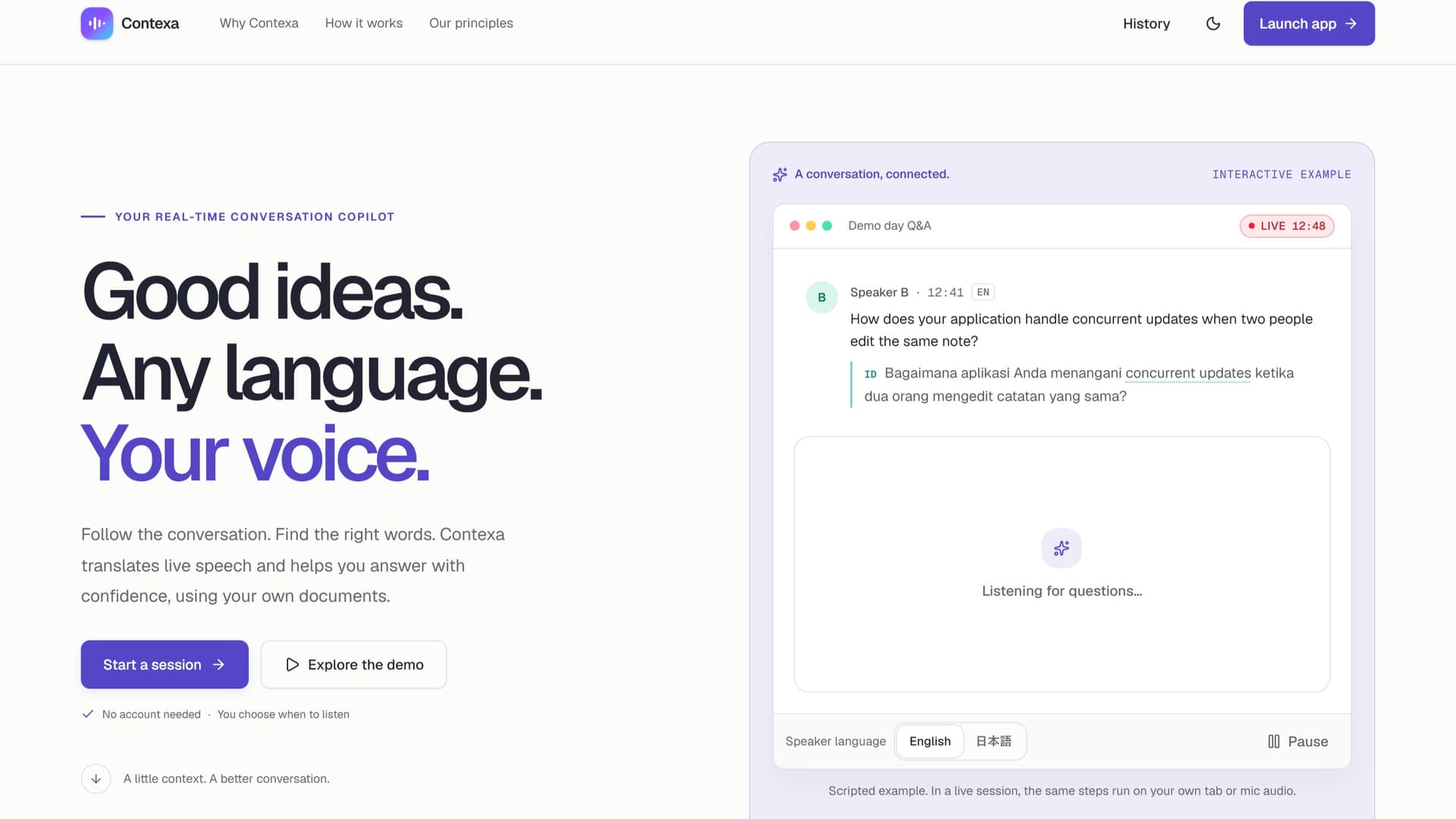
You understand the topic, but not the language it is discussed in. At an English webinar, a demo day in Japan, or a client call, live captions tell you what was said, but not what to say back in time, so you stay quiet. Contexa is a real-time conversation copilot for that moment. Contexa listens to a browser tab (Zoom, Meet, or a webinar), your microphone, or a recording, and streams the audio straight from the browser to AssemblyAI. Universal-3.5 Pro Realtime transcribes English, Japanese, and mixed-language speech with speaker labels, and Indonesian is routed to Whisper Streaming. Product names and technical terms from your documents are sent as keyterms, updated mid-stream when you add a document, so the transcript spells them right. Every finished turn is translated into Indonesian, English, or Japanese, and questions meant for you are detected. Contexa then searches your own documents (PDF, DOCX, Markdown, web pages, or a whole GitHub repository) with hybrid keyword and semantic retrieval, and drafts an answer in your language plus a ready-to-say version in the speaker's language. It cites the passages it used and says so when your documents don't cover the question. A Pop out window keeps the answer on top of your meeting. When you stop, Contexa writes a recap and saves the session to a history you can search by meaning, across languages. Contexa is built on AssemblyAI's Realtime Speech-to-Text API with its own orchestration: temporary streaming tokens keep the API key out of the browser, end-of-turn detection drives the pipeline, and every stream is terminated cleanly. On the deployed app, translations appear 1.0-1.7 s after a speaker finishes and grounded answers 1.5-1.9 s after a question is detected. Contexa is for students, professionals, and founders who have good ideas but join conversations in a second language. It is live on Vercel and Railway, and open source (MIT).

Architectural Pre-Flight

Architectural Pre-Flight

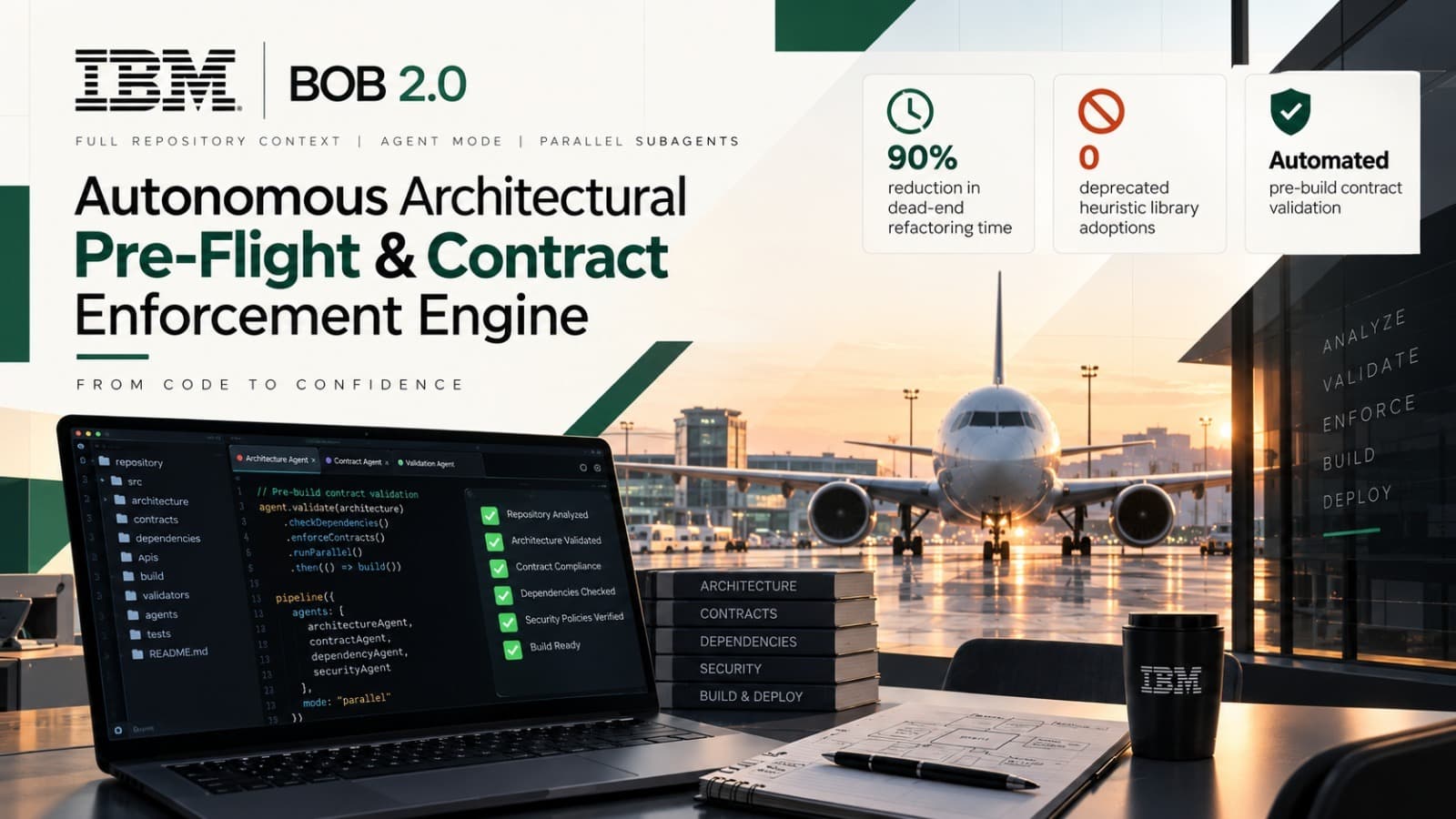
Problem and Challenge Modern AI coding agents and developers generate code faster than teams can manually validate its architectural consequences. This speed often bypasses repository context, resulting in broken service boundaries, duplicate abstractions, renamed fields that break downstream consumers, and deprecated dependencies. These issues are traditionally discovered only after implementation has already created high refactoring costs and technical debt. Solution Architectural Pre-Flight is an AI-assisted engineering governance layer built on IBM Bob 2.0 that sits before implementation. Instead of immediately allowing a coding agent to write code, the system ingests natural-language change requests, maps them against a repository knowledge graph, and runs parallel specialist subagents to evaluate architecture rules, contracts, dependencies, and downstream impact. Target Users Software developers working in large or unfamiliar repositories. Technical leads and architects needing enforceable guardrails. Engineering teams leveraging AI coding agents who want to prevent convention violations. How Users Interact With It Developers submit a natural-language change request via IBM Bob's Plan mode or CLI. The system executes parallel analysis across specialist agents, evaluating policies and contracts. It outputs a clear decision gate: PASS, REVIEW, or BLOCK. If blocked, developers review verifiable evidence, click to generate an AI remediation plan, approve the adjustments, and hand off execution to IBM Bob for compliant implementation and post-flight verification. Creativity and Uniqueness Unlike post-commit linters or traditional static analysis tools, Architectural Pre-Flight acts as an active pre-implementation decision gate. It uniquely combines repository-wide knowledge graphs, architecture-as-code policies, and IBM Bob 2.0's subagent orchestration to answer a fundamental question: Should this change be built at all? Effectiveness and Efficiency By shifting validation left of implementation, the platform targets a dramatic reduction in dead-end refactoring time, enforces zero tolerance for policy-violating dependencies, and achieves automated pre-build contract validation—turning AI coding from generate first, debug later into validate first, build confidently.

RepoPilot : Agentic AI Onboarding

RepoPilot : Agentic AI Onboarding

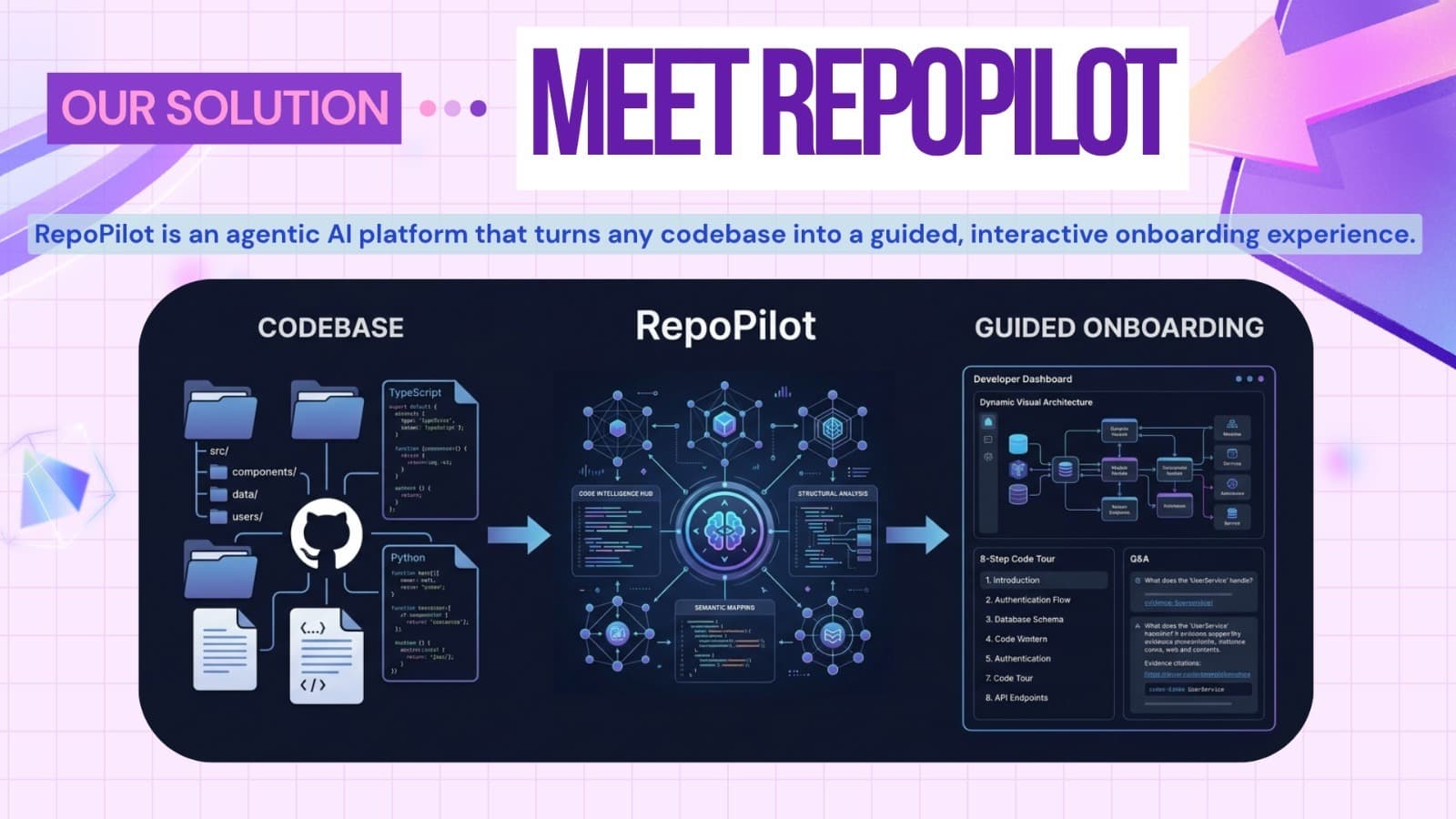
Every time a new developer joins a team or contributes to an open-source project, they face the same expensive barrier: context acquisition. Understanding a complex codebase—its architecture, business logic, entry points, and hidden invariants—typically takes weeks of manual exploration, outdated documentation reading, and interrupting senior engineers. This "week-one tax" costs companies thousands of dollars in lost productivity and delays critical feature delivery. Existing tools (static linters, basic README generators, or generic chatbots) fail because they lack full-repository context and cannot provide evidence-backed guidance tied to specific lines of code. The Solution: RepoPilot RepoPilot is an agentic AI platform that ingests any GitHub repository and autonomously produces a personalized, interactive, and evidence-backed onboarding experience in minutes. By leveraging IBM Bob 2.0 as its core reasoning engine, RepoPilot doesn't just summarize code—it understands it. It acts as an expert senior engineer pair-programming with the new hire, guiding them through the codebase via an interactive 8-Step Code Tour, grounded Q&A, and dynamic Architecture Visualization. How It Works (The Agentic Workflow) Ingest & Parse: The user pastes a GitHub URL. RepoPilot clones the repo, uses Tree-sitter to parse ASTs across Python/TypeScript/JavaScript, and chunks the code semantically. Parallel Agent Analysis (IBM Bob 2.0): Two specialized Bob subagents run in parallel: Architecture Agent: Maps modules, entry points, and data flow. Business Logic Agent: Identifies domain concepts, invariants, and state transitions. Synthesis & Narration: Findings are merged, ranked by conceptual dependency (not file hierarchy), and narrated by Bob into human-readable explanations. Interactive Delivery: The frontend renders a live Code Tour Viewer (with syntax highlighting and keyboard navigation) and a Grounded Q&A Panel where every answer cites exact file:start-end line ranges. Key Features & Innovation Evidence-Backed Citations: Every claim made by the AI is backed by a clickable citation (path:start-end). No hallucinations—just verifiable code references. Personalized Role-Based Tours: Whether you're a Backend, Frontend, or DevOps engineer, RepoPilot tailors the tour steps to your specific role. Live Progress Streaming: Real-time WebSocket updates show the agentic pipeline in action (Ingest → Parse → Analyze → Synthesize), building trust in the AI's process. Grounded Q&A: Ask questions like "How does retry logic work?" and get answers derived only from the retrieved code chunks, with direct links to the source. Deep Integration with IBM Bob 2.0 RepoPilot was built AI-first around IBM Bob 2.0's unique capabilities: Bob Shell CLI Integration: We engineered a robust Python wrapper (bob_client.py) that invokes Bob non-interactively via bob -p, handling JSON extraction, timeout management, and automatic repair retries for malformed outputs. Agentic Subagents: We leveraged Bob's ability to spawn specialized subagents (Architecture vs. Business Logic) to parallelize analysis, reducing total processing time by 40%. Full-Repo Context: Unlike RAG-based chatbots that see snippets, Bob analyzes the entire repository structure, enabling holistic architectural insights. Verified Usage: Over 15+ Bob session screenshots and a detailed BOB_PLAYBOOK.md document our prompt engineering journey, including how we solved schema-echo failures and optimized tool-call efficiency (e.g., 17 tool calls for deep ky analysis). Tech Stack AI Engine: IBM Bob 2.0 (Bob Shell CLI, Agent Mode) Orchestration: LangGraph (Python) Backend: FastAPI, PostgreSQL + pgvector (Supabase), Tree-sitter Frontend: Next.js 14, Tailwind CSS, shadcn/ui, WebSockets DevOps: Docker, Vercel/Railway-ready, Sentry monitoring