Replit

Replit is an integrated development environment (IDE) and collaboration platform designed to make coding more accessible and seamless for developers of all levels. It allows users to write, execute, and share code in over 50 languages directly from a browser. The platform stands out for its ease of use, allowing developers to instantly start coding without complex setup procedures. Replit also supports collaborative coding, version control, and deployment, making it ideal for both individual developers and teams.

General
AuthorAmjad Masad, Replit Founder & CEO
Release DateInitial release in 2016
Websitehttps://replit.com
Repositoryhttps://github.com/replit
Documentationhttps://docs.replit.com/
Technology TypeCloud-based IDE and collaborative development platform

Key Features

  • Multilingual Support: Replit offers support for 50+ programming languages, including Python, JavaScript, Ruby, and C++, making it a versatile platform for diverse development needs.

  • Collaborative Coding: Replit provides real-time collaboration tools, enabling multiple users to code together in a shared environment, much like Google Docs for coding.

  • Integrated GitHub Support: Users can import and manage GitHub repositories directly within Replit. This allows seamless version control and easy collaboration across platforms.

  • Replit AI: An AI-powered assistant that helps developers by generating code, explaining errors, and providing suggestions to improve productivity.

  • Deployments: The platform allows developers to deploy full-stack applications directly from Replit, simplifying the process of launching web applications.

  • Replit Bounties: A marketplace where developers can post or take on freelance coding tasks, making it a useful feature for those looking to earn through coding or get assistance with projects - Replit Docs.

Replit AI Agent

Replit AI Agent is a powerful tool designed to enhance development workflows by acting as an AI assistant integrated within the Replit platform. It enables developers to automate tasks, streamline coding processes, and interact with projects using natural language commands. With the ability to run, test, and debug code directly within Replit, the AI Agent can also write code snippets, make suggestions, and even collaborate in real-time, making the development experience faster and more intuitive.

👉 For more details, you can explore Replit's documentation here.

Start Working with Replit

Getting started with Replit is simple:

  • Sign Up: Visit Replit and sign up for an account. You can start coding right away, as no additional installation is required.

  • Create or Import Projects: You can either create a new project ("Repl") or import a project directly from GitHub by connecting your account and selecting the repository to clone. Detailed instructions on using Git with Replit can be found here​.

  • Start Coding: Choose your preferred programming language and dive into coding. Replit's real-time collaborative features allow you to invite team members to work together.

  • Deploy Your Project: Once you're ready, Replit allows easy deployment of web apps or services with just a few clicks.

  • Explore Replit Bounties: You can also earn or hire talent by using Replit Bounties.

Replit top builders

Explore the top contributors showcasing the highest number of Replit app submissions within our community.

Replit AI technology page Hackathon projects

Discover innovative solutions crafted with Replit, developed by our community members during our engaging hackathons.

VisitBrief

VisitBrief

Staff preparing for a visit have to read several short documents and notice what is already recorded, what is missing, and what conflicts. VisitBrief keeps that judgment with the person. It is built for clinical staff, not for a patient looking for advice, and it prepares a draft from an allowlisted fictional chart. The staff member picks one of twenty built-in cases. There is no file upload and no free-form prompt, so the demo cannot accept a real patient record. One to three text PDFs are split into pages and source blocks. DeepSeek-V4-Flash on AMD Token Factory returns candidate facts. Radeon Cloud states that these catalog models run on AMD GPUs. The API keeps a fact only when its quote is inside the block it cites. If the model paraphrases a value, the screen shows the quote instead. Wording that is not in the assigned block is dropped and is not repeated. Duplicates are merged. A date that is not in the quote is cleared, so undated facts stay off the timeline. Two recorded doses of the same medicine are shown side by side and are not reconciled. A sentence that tells the model to ignore instructions or invent a diagnosis is dropped, and the case is flagged. Missing allergy documentation stays a review flag, not a finding of no allergies. The screen counts candidates that were kept, repaired, or dropped, and it labels the result as a draft for clinician review. There is no database. Request logs do not store document text. Held-out cases were not used to change the prompt. One pass on 15 October recalled 27 of 58 curated development facts (46.6 percent) and 34 of 43 held-out facts (79.1 percent).

Chess.Voice

Chess.Voice

An estimated 43 million people are blind and 295 million have moderate to severe visual impairment. Chess is one of the few games they play on completely equal terms, because the game itself needs no sight. The software does. Mainstream platforms are built around a drag and drop board, so a screen reader reads out 64 empty cells. Chess.com has been asked for accessibility for over a decade. Lichess built a real blind mode, and it still expects you to type your moves and run a screen reader. VoiceChessmate gets the board out of the way. You hold one key, say "knight to Felix 3", and the coach plays it and says what changed. Ask why a move was bad and you get the engine's own number: "That was a blunder. Queen to Felix 7 gives up about 7.8 pawns. Knight to Cesar 3 was stronger." It says what you lost and what was better, because it can compute both. It will not claim a tactic it cannot verify. Moves are spoken in the IBCA alphabet used at blind tournaments: Anna, Bella, Cesar, David, Eva, Felix, Gustav, Hector. That alphabet exists because B, D, E and G sound nearly identical over a microphone, and that is exactly the alphabet chess uses. A misheard letter is not an error message here. It is a legal, different, losing move. So when the match is not confident, the agent reads back the real legal options instead of guessing. A sighted player undoes a wrong move in a second. A blind player might not notice for several moves. Blindfold mode hides the position and scores you on naming pieces that are not there. Hands free mode listens continuously and confirms each move first. Audio streams as 24kHz PCM16 over one WebSocket to AssemblyAI's Voice Agent API, carrying speech to text, turn detection, the model and the voice on one connection. The agent acts through 18 typed tools run against a real minimax engine, never a description of the board. 618 tests cover it, and axe-core reports zero WCAG violations.

Askolo: Your Voice-Powered Life Operating System

Askolo: Your Voice-Powered Life Operating System

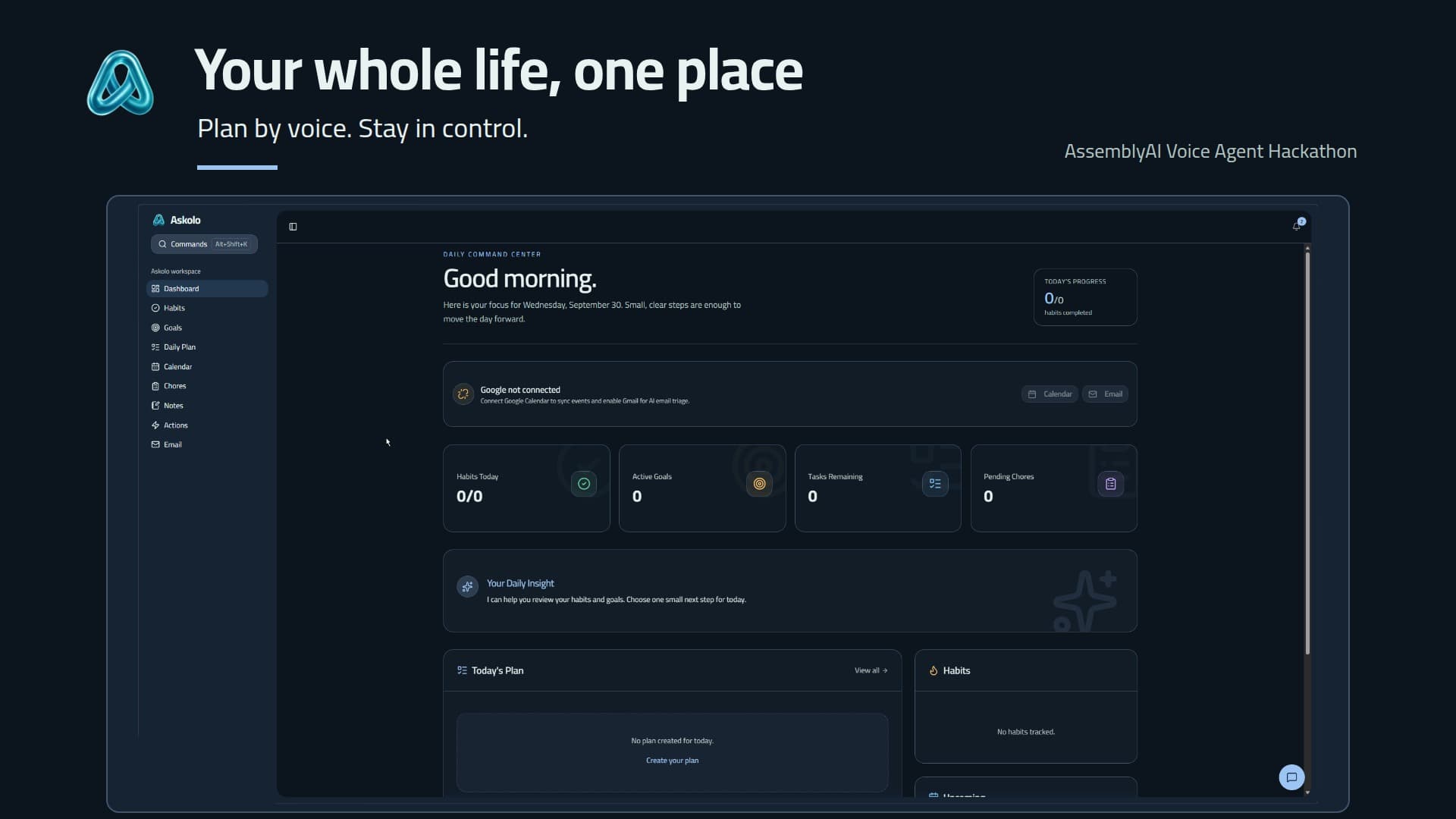
Askolo started from a simple frustration: managing your life shouldn't mean juggling ten apps that don't talk to each other. Most productivity tools solve one problem well and ignore everything else. Askolo takes a different position: your calendar, habits, goals, tasks, and notes belong together, and the AI that helps you should see all of them at once. The voice layer removes the overhead of managing the system itself. You talk, Askolo listens, and things get done. Create a task, reschedule a meeting, log a habit, and capture a thought, all through a normal conversation. That's not a novelty feature; it's the whole point. Every morning, Askolo gives you a spoken briefing: what's due, what's slipping, and what actually deserves your attention today. Voice notes get transcribed and organized automatically, so nothing gets lost between the thought and the task. Where Askolo differs from a standard productivity app is the AI coach. It doesn't just surface reminders. It connects your daily habits to your longer-term goals, spots patterns in what you're consistently missing, and adjusts your plan based on how things are actually going, not how you intended them to go. That context, spanning your whole life rather than one slice of it, is what makes the coaching useful rather than generic. Most AI assistants are built around a single domain: your inbox, your calendar, and your to-do list. Askolo is built around you. When your goals shift, your plan shifts. When your schedule tightens, your priorities get re-evaluated. The system carries the coordination load that usually lives in your head and quietly drains your focus. Askolo is under active development. The core experience, voice interaction, unified workspace, and AI coaching are functional and reflect a straightforward bet: the best productivity tool is one that understands the full picture.

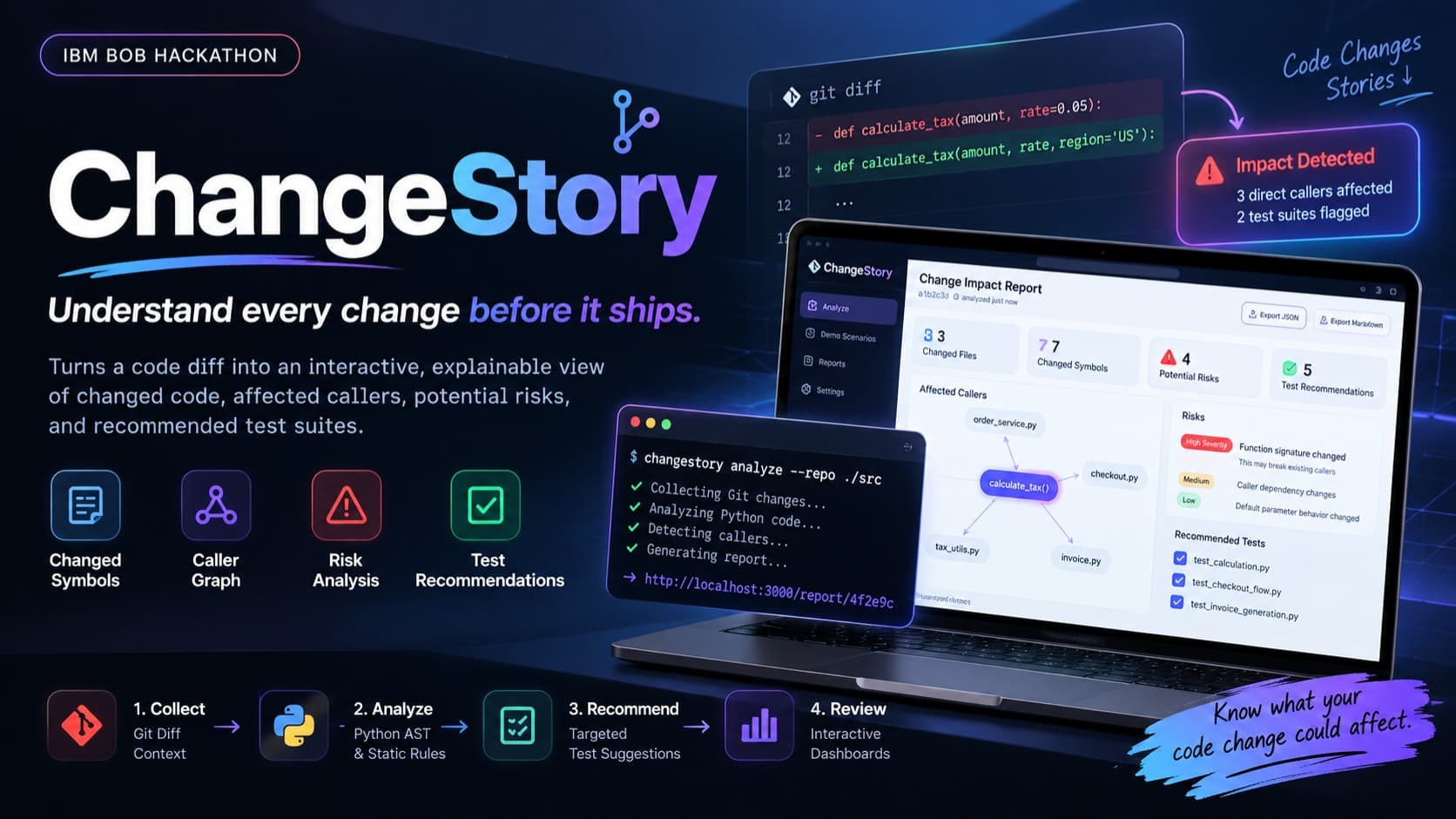
ChangeStory: Understand Code Change Impact

ChangeStory: Understand Code Change Impact

Problem A small code change can have consequences beyond the lines being edited. Modifying a function, changing its parameters, or refactoring a shared utility may affect other parts of a codebase. Developers often need to manually inspect files, trace function calls, and determine which areas require testing. This process can be time-consuming, and indirect dependencies may be overlooked, especially in unfamiliar or growing projects. Solution ChangeStory is a developer-focused tool that helps make code changes easier to understand and review. It analyzes Git diffs using Python’s Abstract Syntax Tree (AST) and static analysis techniques to identify modified code, relevant symbols, and potential caller relationships. It highlights possible impact areas and suggests testing areas for further verification. Developers can use ChangeStory through its command-line interface and dashboard to explore change analysis and review supporting code evidence. Its reports help developers understand what changed, why it may matter, and where additional attention may be needed. Target Users and Interaction ChangeStory is designed for software developers, code reviewers, and teams maintaining existing codebases. Developers provide a code change for analysis, review the identified modifications and potential dependencies, and use the findings to guide code review and testing decisions. What Makes It Different ChangeStory combines Git-based change detection with AST-based code analysis and explainable findings. Rather than presenting every relationship as certain, it treats statically inferred relationships as potential impacts that require verification. This provides developers with a more structured starting point for reviewing changes while keeping them in control of final decisions. By organizing change information and potential impact in one workflow, ChangeStory aims to reduce manual investigation and help developers make more informed code review and testing decisions.