xAI

xAI is an innovative AI technology company founded by Elon Musk in July 2023. The company is dedicated to pushing the boundaries of artificial intelligence by creating tools and platforms to advance scientific discovery, foster understanding, and simplify complex problem-solving. With cutting-edge technology and a user-focused approach, xAI provides developers and organizations with the tools they need to unlock the potential of AI in everyday applications.

General Information

AttributeDetails
CompanyxAI
Founded2023
Documentationhttps://docs.x.ai/docs
API Referencehttps://docs.x.ai/api#introduction

Products

Grok AI Models

xAI's flagship product line consists of the Grok series of conversational AI and vision-enhanced models:

  • Grok-1: xAI's foundational model offering robust reasoning and conversational capabilities.

  • Grok-1.5: Improved reasoning and extended context for handling large datasets.

  • Grok-1.5V: Introduced vision capabilities for analyzing images and diagrams.

  • Grok-2: Enhanced performance with advanced image generation and multimodal abilities.

xAI API

An accessible platform for developers to integrate Grok models into their applications. Fully compatible with existing OpenAI and Anthropic SDKs.

PromptIDE

A powerful integrated development environment for crafting, testing, and refining AI prompts. Designed to optimize prompt engineering workflows for large language models.

Start Building with xAI

👉 Visit x.ai to create a developer account and get started.

👉 Sign in to the xAI Developer Portal to obtain API keys, access Grok models, and explore documentation.

xAI AI Technologies top builders

Explore the top contributors showcasing the highest number of xAI AI Technologies app submissions within our community.

xAI AI Technologies Hackathon projects

Discover innovative solutions crafted with xAI AI Technologies, developed by our community members during our engaging hackathons.

MediAlert AI — Emergency Decision Support Platform

MediAlert AI — Emergency Decision Support Platform

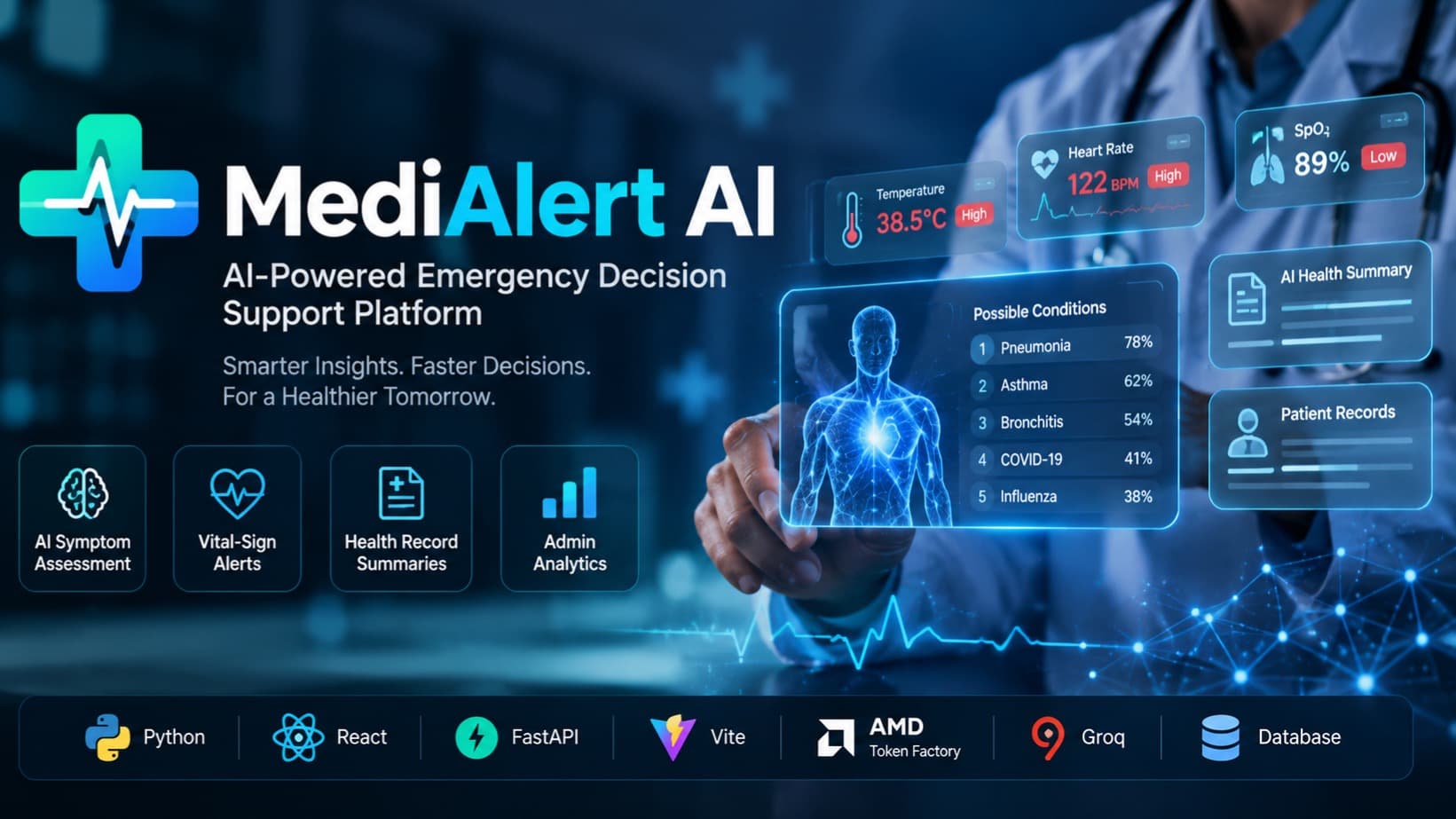
MediAlert AI is an AI-powered emergency decision support platform designed to help users organize health information, assess reported symptoms, identify potentially concerning vital signs, and understand health records through AI-assisted insights. Key Features • AI-Assisted Symptom Assessment: Combines structured symptom matching with AI-powered ranking and explanations to present up to five possible conditions from its supported disease list. Results are preliminary possibilities, not confirmed diagnoses. • Vital-Sign Alerts:Highlights potentially concerning readings using configured thresholds, including temperature above 38°C, pulse above 120 BPM, and SpO₂ below 90%, encouraging timely medical evaluation. • AI Health Summaries: Generates concise summaries of available health records to make relevant information easier to review. • Role-Based Workflows:Supports separate patient and administrator workflows, along with health information management and analytics. AMD AI Integration MediAlert integrates AMD Token Factory with the DeepSeek-V4-Flash model for AI-assisted symptom-result ranking, explanations, and health-record summaries. A Groq-based fallback is configured to support resilience when the primary provider is unavailable. Technology Stack React, Vite, Python, FastAPI, AMD Token Factory, DeepSeek-V4-Flash, and Groq. Impact and Responsible Use MediAlert aims to make health information more accessible, highlight potentially concerning vital signs, and support informed healthcare decisions. It is a decision-support prototype, not a replacement for professional medical advice, diagnosis, or treatment. AI outputs may be incomplete or incorrect, and users should consult qualified healthcare professionals for medical concerns. Suspected emergencies require immediate assistance from local emergency services.

VisitBrief

VisitBrief

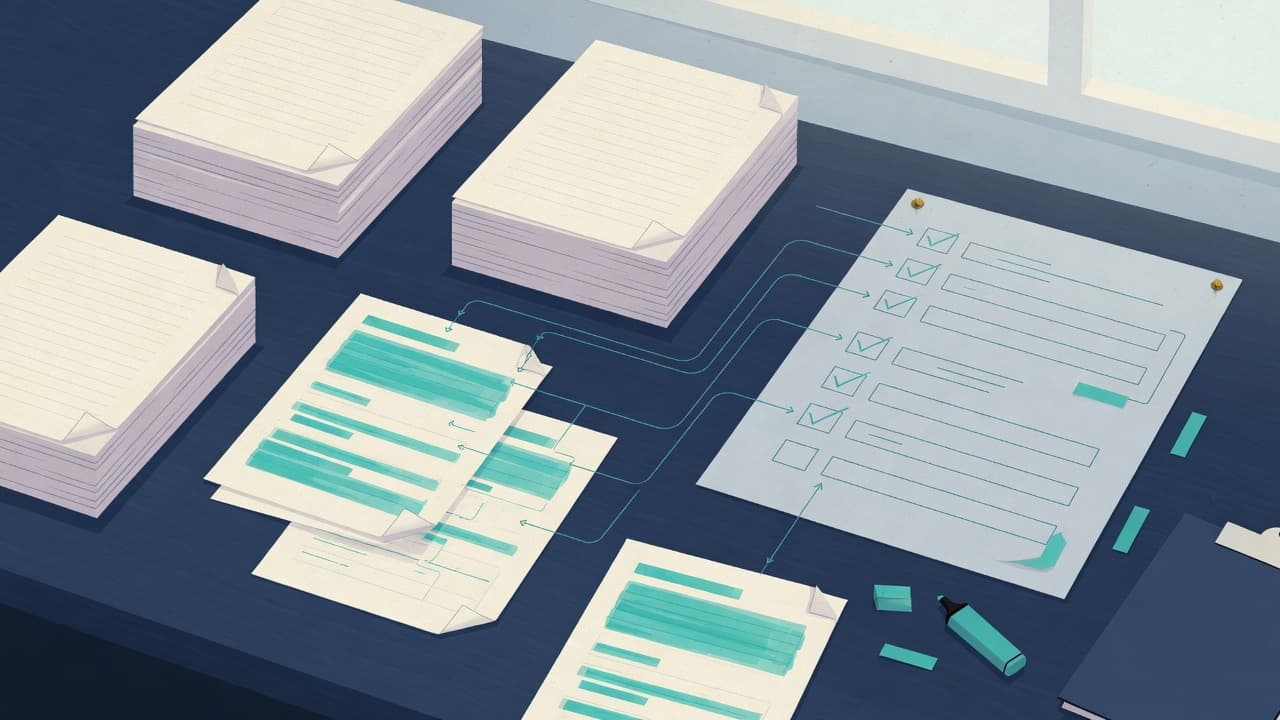
Staff preparing for a visit have to read several short documents and notice what is already recorded, what is missing, and what conflicts. VisitBrief keeps that judgment with the person. It is built for clinical staff, not for a patient looking for advice, and it prepares a draft from an allowlisted fictional chart. The staff member picks one of twenty built-in cases. There is no file upload and no free-form prompt, so the demo cannot accept a real patient record. One to three text PDFs are split into pages and source blocks. DeepSeek-V4-Flash on AMD Token Factory returns candidate facts. Radeon Cloud states that these catalog models run on AMD GPUs. The API keeps a fact only when its quote is inside the block it cites. If the model paraphrases a value, the screen shows the quote instead. Wording that is not in the assigned block is dropped and is not repeated. Duplicates are merged. A date that is not in the quote is cleared, so undated facts stay off the timeline. Two recorded doses of the same medicine are shown side by side and are not reconciled. A sentence that tells the model to ignore instructions or invent a diagnosis is dropped, and the case is flagged. Missing allergy documentation stays a review flag, not a finding of no allergies. The screen counts candidates that were kept, repaired, or dropped, and it labels the result as a draft for clinician review. There is no database. Request logs do not store document text. Held-out cases were not used to change the prompt. One pass on 15 October recalled 27 of 58 curated development facts (46.6 percent) and 34 of 43 held-out facts (79.1 percent).

Culltron CivicOps

Culltron CivicOps

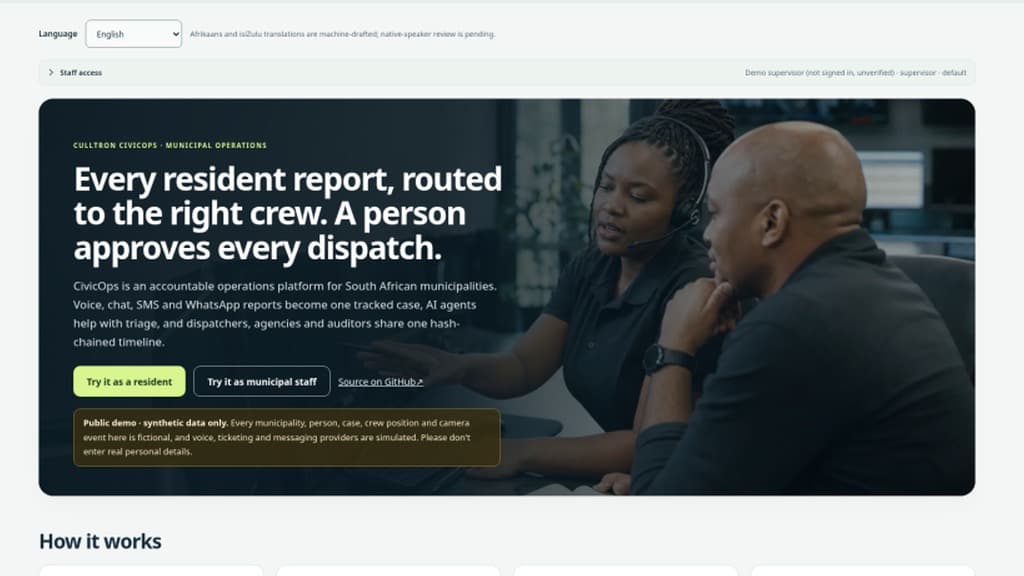
The problem. In a South African storm, municipal call centres flood. Reports arrive by phone, WhatsApp, email and walk-ins, and get re-typed, lost or duplicated. Residents never learn what happened, and control rooms cannot show who decided what. What CivicOps does. One front door: residents report by voice, chat, SMS, WhatsApp, web form or Open311 and get a reference number. On the live demo the resident agent is an ElevenLabs conversational agent using short-lived signed sessions. Bounded agents (Gemini 3.5 Flash-Lite, with a deterministic fallback) extract facts, triage, flag duplicates, recommend an eligible crew and draft resident updates, recording provider, model, confidence and reasoning. Agents cannot approve, assign or send anything: a dispatcher approves and assigns, and a supervisor names the incident commander and decides mutual aid. A live map shows aggregated operations only, with no person tracking. Multiple agencies share one incident and timeline. SOS needs a deliberate 3-second hold and never replaces 10111, 10177 or 112. Every action goes into an append-only SHA-256 hash-chained audit trail verifiable in the browser. Hard spend caps switch the demo to a labelled simulation. Honest scope. The demo uses synthetic data (EXPLICIT DEMO); email goes to an outbox only and field responses are simulated; Afrikaans and isiZulu translations await native review. An AMD Instinct/vLLM open-model path is implemented but was not run on AMD hardware for this event.

Dark Fulcrum Force

Dark Fulcrum Force

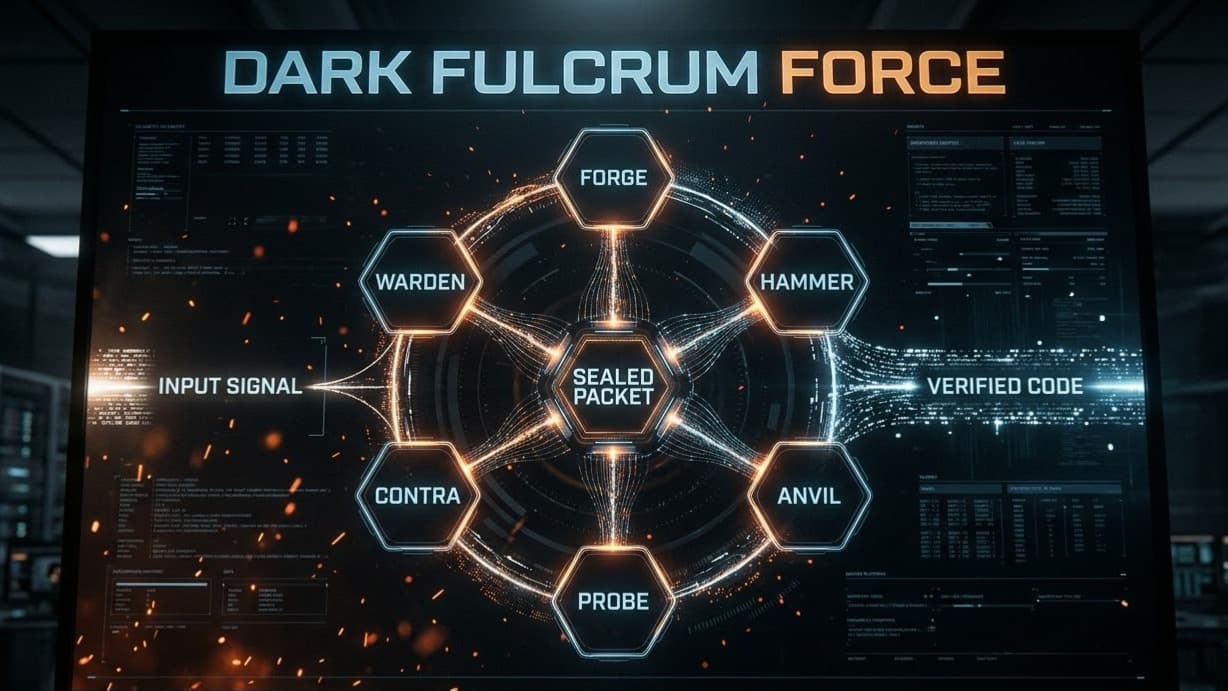
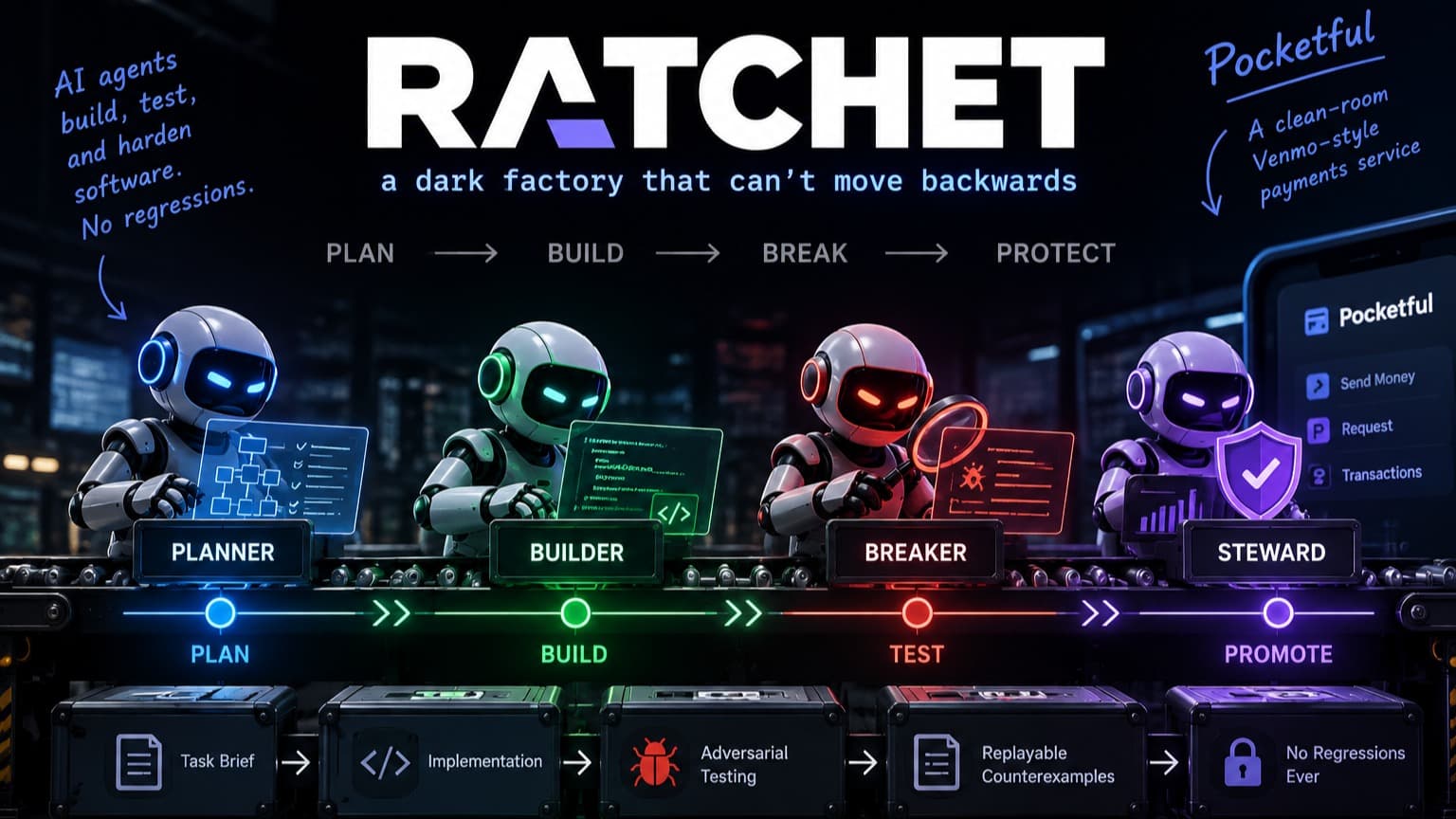
Dark Fulcrum Force is our tablekeeper entry for the WeAreDevelopers × BAND Dark Factory hackathon: an autonomous "factory" of six coding agents that turns one operator dispatch into shipped, verified software with no human in the loop afterward. The band has six seats, each with one job and a generic mandate that carries no track-specific details — the specifics live only in the dispatch, so the same mandates work on any project. FORGE plans the work and issues sealed handoff packets; each packet's hash covers the spec, base revision, target seat, and a lease built from handoff and attempt numbers, and every receiving seat verifies the seal before acting. HAMMER and ANVIL implement the same stage independently — one in Python, one in Node, on different models — without seeing each other's code. PROBE runs the supplied tests plus its own probes against each build; CONTRA attacks both adversarially; WARDEN keeps the full evidence trail. In the run that produced this submission, the operator created and bound the seats, then posted one dispatch at 9:15 PM Central — the only human message in the room. Review caught a defect in one build; ANVIL's repaired build passed the checks and became the merged base. The result is tablekeeper, a restaurant reservation service built so a table is never double-booked under concurrency, retries, and time zones. It builds and serves from a clean container with no outbound network and passes all 120 shipped Stage 1 checks. Everything — the factory, the mandates, the room recording, and the code — is in the public repo.

Pocketful by InCarousel

Pocketful by InCarousel

Pocketful is a self-contained wallet application built through a four-seat BAND software factory. People send money by handle, request payments, split bills to the last cent and reserve funds. Four independently buildable stage folders implement the challenge's API, browser recovery, historical corrections and atomic batch changes. Codex owns the interface and independent runtime checks. Tony implements and repairs the backend through Hermes. Saturn analyses requirements and plans work. DeepResearch reviews sources and evidence. BAND records their full-task handoffs; the native dispatcher retains execution authority. These development agents are not dependencies of the shipped application. Final source 4573d5b7 passes fresh-clone isolated published checks in every stage: 147, 182, 188 and 193 inherited checks respectively. Ten independent runtime groups and sixteen custom adversarial groups pass against matching Docker images and served assets. A separate source review verifies the retained bundle, ordinary Git history and bounded local checks. Custom testing caught a defect after the published suite passed: the same retry key treated number 1 and an ordinary object as identical, returning a false replay. We preserved the failure, requested a scoped author repair and reran the unchanged negative probe. The repaired service returns 409 and leaves its entire exported state unchanged. The film shows the actual recorded BAND handoff and completed application results, held for reading. The final factory run elapsed about 2 hours 23 minutes; model spend and human time were not measured. This is a synthetic challenge wallet, not a bank integration. Public tests and custom probes do not guarantee hidden-test results or production financial readiness.