🤓 Latest Submissions
NumeriGuard
NumeriGuard is a proposed numerical validation platform for industrial R&D teams that depend on simulation, scientific computing, and engineering software. It helps developers detect when changes to code, compilers, GPU drivers, numerical libraries, or hardware alter the accuracy, stability, or performance of their calculations. The platform turns trusted engineering examples into repeatable tests. Teams define acceptable errors, physical constraints, convergence requirements, and runtime limits. NumeriGuard then executes those tests across selected environments, compares results against appropriate references, and produces evidence explaining whether a change meets the agreed acceptance criteria. Its core capabilities include floating point comparisons, conservation checks, mesh convergence analysis, repeated execution for nondeterministic workloads, performance regression detection, and reproducible failure packages. Engineers can trace unexpected results to the exact inputs, software versions, hardware configuration, and execution settings involved. AMD ROCm would support GPU execution and profiling, while AMD Developer Cloud would provide development and benchmarking resources. Supported Radeon hardware would enable local validation. Ryzen AI could support a later extension for testing compact engineering inference models against their references. The initial MVP would validate one thermal solver and one structural solver through a command line interface and CI integration. A review interface would show numerical differences, performance changes, and downloadable reproduction bundles. Designed for simulation vendors, manufacturing R&D groups, and research computing teams, NumeriGuard aims to reduce debugging effort and improve confidence in engineering releases. It evaluates defined numerical requirements
18 Oct 2026
LedgerTrail AI
LedgerTrail AI combines a transparent digital wallet with an autonomous team of coding agents that builds and checks the software behind it. The project addresses a fundamental problem in payments: users need to understand how their balance changed, especially when transactions are corrected, funds are reserved, or refunds arrive later. The wallet supports payments between users, payment requests, bill splitting, group settlements, reserved funds, partial captures, and refunds. Its central feature is an interactive financial timeline. Users can inspect the original transaction, follow subsequent changes, and understand how each event affected their available and reserved balances. LedgerTrail AI preserves two perspectives on history: when an event took effect and when information about it became known. This allows users to revisit a statement as it appeared at an earlier moment and compare it with the current, corrected view. Corrections become additional linked records, preserving the earlier information and the explanation for the change. For example, a user reviewing a payment from last month can see the original record, a correction recorded this week, and the resulting difference between historical views. Support teams and finance users gain a clear trail for investigating discrepancies. The software is produced inside BAND Desktop by agents with distinct responsibilities: planning, service implementation, interface development, and independent verification. The planner converts each stage’s specification into work packages. Builders implement the application and hand over code with executable evidence. The verifier derives its own checks from the requirements, challenges unsupported claims, and returns reproducible failures for repair. Verification focuses on conserving money, preventing duplicate payments, handling concurrent spending, maintaining exact split arithmetic, and preserving historical records through upgrades. .
6 Oct 2026

ClaimDeskAI
The product should feel less like a chatbot and more like an enterprise verification operating layer. A user asks a question by voice, ClaimDeskAI gathers permitted evidence, executes calculations in isolated containers, uses organizational memory for context, identifies contradictions, and returns an answer with a complete audit trail. Core product workflow Voice question → understand claim → retrieve evidence → run verification → calculate → compare → explain → show sources → save case → update organizational memory ClaimDeskAI doesn't merely answer enterprise questions—it proves where the answer came from, calculates it reproducibly, remembers organizational context safely, and refuses to claim certainty when the evidence is incomplete.
30 Sep 2026
CircleCompute AI
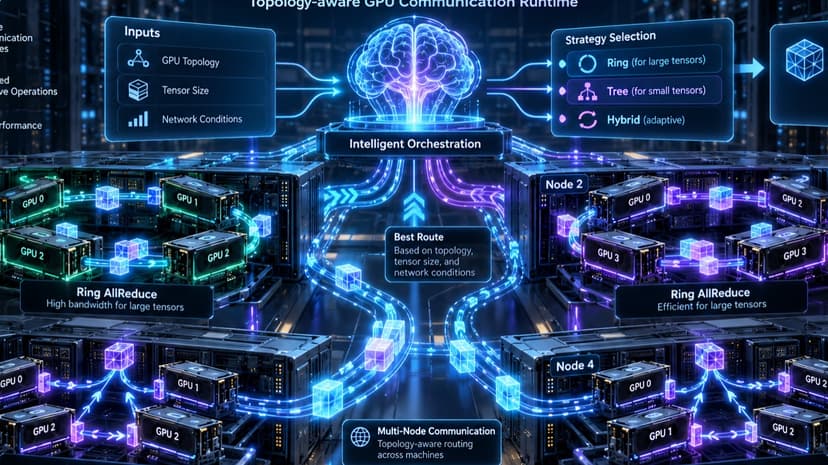
Modern distributed AI workloads frequently move large tensors between GPUs, and communication can quickly become a major performance bottleneck.Analyzes the underlying machine topology—including GPU-to-GPU links, PCIe paths, NUMA placement, network bandwidth, and inter-node connectivity—and selects an appropriate communication schedule for the current workload. The initial MVP implements FP32 AllReduce using two different communication strategies: Ring AllReduce and a hierarchical Tree-based AllReduce. The runtime supports chunk pipelining, asynchronous communication, CUDA streams, overlapping computation with data transfers, timeout handling, and configurable transport layers such as sockets or UCX. The system runs across four GPUs distributed over two hosts, while NVIDIA NCCL is used as both a correctness and performance baseline. benchmarks multiple tensor sizes, chunk configurations, pipeline depths, and network conditions to understand when each communication strategy performs best.
27 Sep 2026

BimanualIQ
BimanualIQ is a voice-controlled Physical AI system designed for intelligent two-arm robotic manipulation. It combines natural-language understanding, visual perception, multimodal reasoning, motion planning, and coordinated execution to let users control two robotic arms through simple spoken instructions. In the core demo, a user can say, “Set the table for two, and do not use the red cup,” and BimanualIQ interprets the request, detects objects in the scene, builds a task plan, assigns actions to each arm, and completes the table-setting workflow inside MuJoCo. The system uses Speechmatics for real-time speech recognition, camera observations for scene understanding, and a VLA-based reasoning layer for translating intent into physical actions. A bimanual coordinator decides when the arms should work independently, perform handoffs, stabilize objects, or execute synchronized movements. BimanualIQ also monitors execution continuously, allowing it to detect failed grasps, misplaced objects, unexpected disturbances, and new voice commands, then replan without restarting the entire task. OpenVINO optimizes perception and AI inference for Intel Core Ultra Series 2/3 hardware, while seeded simulation tests measure task completion, robustness, latency, and generalization across randomized environments. The result is a practical, adaptive, and reproducible platform for conversational bimanual robotics. It demonstrates how spoken intent can become physical action.
16 Sep 2026

Newsstrike AI
news-sentiment-driven directional debit spreads Mechanism/angle: Streams Alpaca's real-time news websocket; an LLM (served cheaply via featherless.ai's flat-rate open-weight models — e.g. Llama/Qwen/DeepSeek) classifies each headline's sentiment and materiality for a watchlist, and on a strong, fresh signal the agent buys a defined-risk directional debit spread (bull call / bear put) rather than naked shares, capping cost and defining risk. Distinct mechanism: event/NLP-driven directional options, versus the volatility/income mechanisms above The NLP pipeline and real-time news handling are the added complexity, but sentiment→direction→2-leg spread is a well-trodden path (Alpaca publishes a news-sentiment tutorial) and debit spreads keep risk trivially bounded.
4 Sep 2026
AutospyAI
MVP Single intake box: paste error logs, a stack trace, a Slack thread, or just what the client said — one field, no rigid format required Instant dual output, side by side: a client-safe summary (plain language, current status, what's being done, next update time, no jargon or blame) and an internal technical brief (likely root cause with a confidence level, affected systems, relevant log lines pulled out, suggested next diagnostic step) Editable before send — it never auto-sends; the FDE reviews and edits either summary first. Worth keeping front-and-center in the demo, it's a good trust signal for judges Copy-formatted output: one button copies the client version formatted for email/Slack-to-client, another copies the technical version formatted for the internal incident channel Per-client incident history — every incident saved and filterable by client/severity/status, so the log becomes an asset over time, not a throwaway
10 Aug 2026
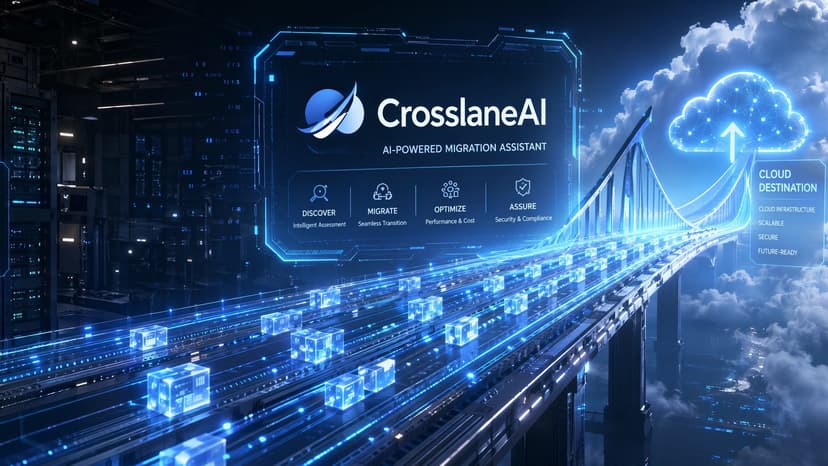
CrosslaneAI
CrosslaneAI is an agentic migration platform that autonomously ports CUDA codebases to ROCm/HIP, so teams can run their GPU workloads on AMD hardware without rewriting a single kernel by hand. For over fifteen years, the entire GPU computing world has been written in CUDA. That accumulated codebase — not the silicon itself — is the real reason teams stay locked to a single vendor. AMD's MI300X is genuinely competitive today, offering 192GB of HBM3 and far better price-per-hour economics, yet most organizations can't make the switch. The migration is manual, slow, error-prone, and expensive enough that it's typically handed to specialist consultants charging weeks of engineering time. PortForge productizes that migration and collapses it from weeks into minutes.
13 Jul 2026
Agentic InferenceRoute
The traditional web services handle quick stateless requests measured in milliseconds, but LLM inference workloads require routing decisions that understand the current state of each model server — queue depth, memory utilization, loaded adapters, and ability to handle requests of different criticality levels. InferRoute adds a Featherless-powered classifier in front of that routing layer, and a band.ai cost-control agent watching the budget knob continuously.In Istio it fully conformant with GIE v1.0.1 and promotes GIE support to beta — separating platform admin concerns from AI/ML team concerns through InferencePool (platform admin resource) and InferenceObjective (AI/ML owner resource). InferRoute rides exactly that wave, adding a Featherless intelligence layer and band.ai budget governance on top of the freshest K8s-native inference primitive. It's not a toy demo — it maps directly to the production problem of routing requests based on KV-cache utilization, pending queue depth, and prefix affinity to minimize time-to-first-token, with cost control that enterprises actually need
19 Jun 2026


