Llama 3.1

Llama 3.1 is a state-of-the-art open-source large language model (LLM) by Meta AI, optimized for advanced NLP tasks and designed for accessibility. It offers multiple sizes, including a massive 405B parameter model, making it the first open-source LLM capable of rivaling major competitors like GPT-4. This positions Llama 3.1 as a groundbreaking open-source solution for large-scale AI tasks. Llama 3.1 emphasizes transparency, safety, and responsible AI usage, with extensive guides for developers. The Llama community fosters open innovation, offering grants and research opportunities.

General
AuthorMeta
Release dateJuly 23, 2024
Websitehttps://llama.meta.com/
Documentationhttps://llama.meta.com/docs/overview
Repositoryhttps://github.com/meta-llama/llama3
Technology TypeLarge Language Model (LLM)

Key Features

  • Open-source and Customizable: Llama 3.1 is open-source, allowing developers and researchers to access, modify, and build upon the model for various projects without licensing restrictions.

  • Scalable Model Sizes: Llama 3.1 offers different sizes, from lightweight models that can run on local devices to larger, high-capacity models suited for extensive computational tasks, catering to various levels of performance needs.

  • Enhanced Transparency and Safety: A significant focus of Llama 3.1 is on transparency and responsible use. The model adheres to ethical AI guidelines, ensuring that it’s designed with safety measures to mitigate risks like bias or misinformation.

  • Extensive Developer Support: Meta provides detailed documentation, integration guides, and resources, ensuring that developers of all skill levels can easily deploy and fine-tune Llama 3.1 for their specific use cases.

  • Community and Research Collaboration: Llama 3.1 fosters an open research environment, encouraging collaborative innovation. Meta offers grants, research opportunities, and an open ecosystem for contributing to the development of the model, making it a hub for AI exploration.

  • Efficient Training and Deployment: The model is designed with optimization for training efficiency, making it easier to run across different platforms without requiring massive computational resources, offering flexibility for cloud, server, or local use.

Start Building with Llama 3.1

Getting started with Llama 3.1 is easy, whether you're a seasoned developer or just starting out with AI. Meta provides a comprehensive set of resources, including detailed documentation, setup guides, and tutorials to help you integrate Llama 3.1 into your applications. You can choose from various model sizes depending on your use case, whether it’s running locally on your device or deploying in a large-scale cloud environment. Llama 3.1’s open-source nature allows for customization and fine-tuning for specialized needs.

👉 Start building with Llama 3.1

Llama 3.1 top builders

Explore the top contributors showcasing the highest number of Llama 3.1 app submissions within our community.

Meta Llama 3.1 AI technology Hackathon projects

Discover innovative solutions crafted with Llama 3.1, developed by our community members during our engaging hackathons.

SortSmart Business Advisor

SortSmart Business Advisor

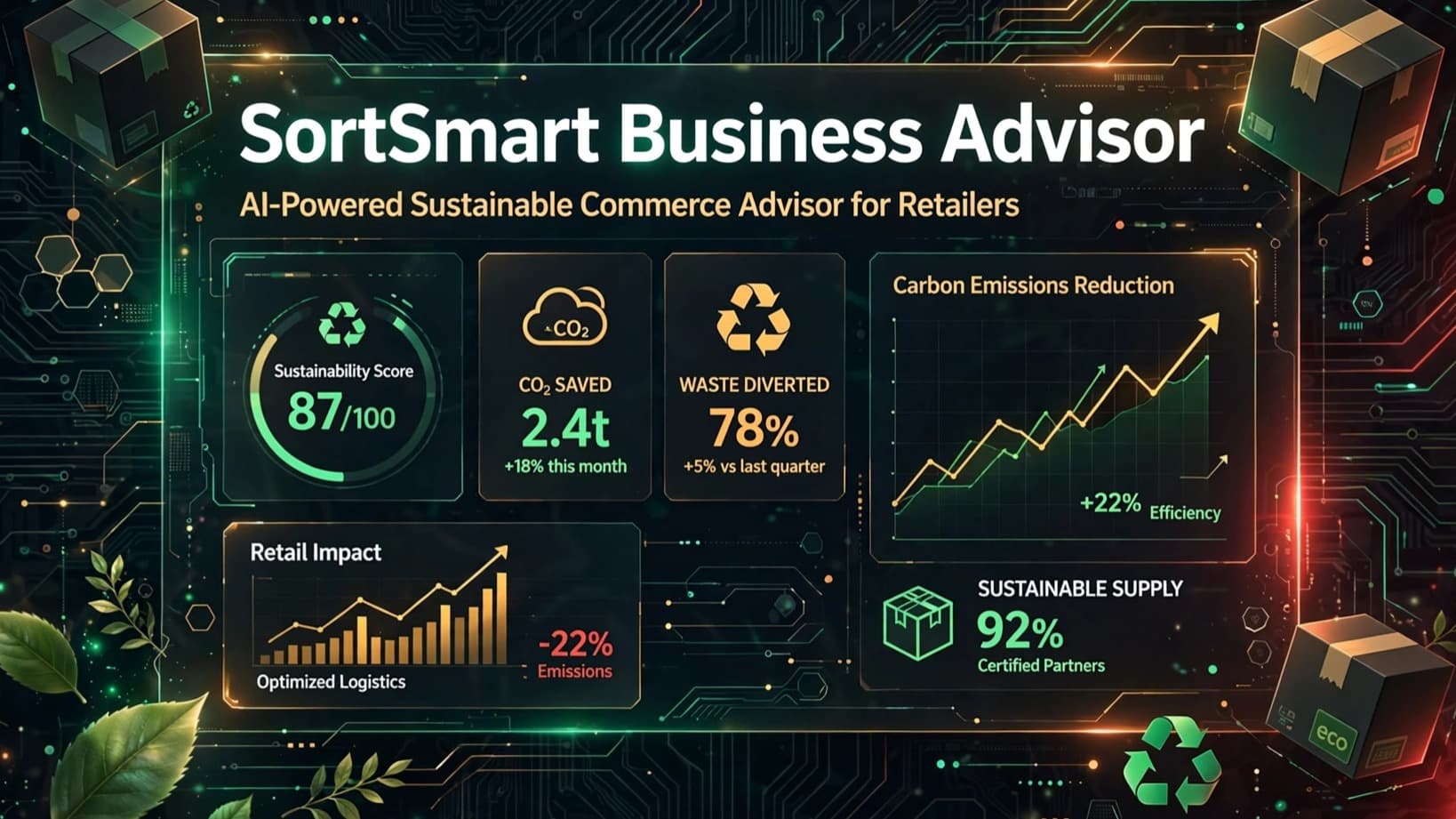
### Inspiration Every day, small and mid-size businesses make packaging and waste decisions with no data: which mailer to buy, whether composting pays off, what their waste actually costs. Sustainability consultants charge thousands for audits most businesses will never buy. Meanwhile, packaging is often a business's most visible environmental footprint — and a controllable cost line. We built SortSmart Business Advisor to put a sustainability analyst on every business owner's phone, for free. ### What it does Ask a plain-English question and get a dollar-quantified answer. The app also produces full business briefs: a 0–100 sustainability score with transparent breakdown, current waste cost estimates, and ranked recommendations with projected annual savings. Every number is traceable to its source — the LLM never invents figures. ### How we built it Three layers: (1) Deterministic rule engine — waste-stream knowledge base, sorting advisor. (2) Business intelligence layer — cost models on US national averages (EPA, tipping-fee surveys), 0–100 sustainability scoring, ROI-ranked recommendations. (3) LLM advisor layer — model-agnostic OpenAI-compatible client; the LLM narrates grounded figures, never calculates. Backend is Python stdlib only; UI is a single HTML file. ### The AMD angle The LLM is the product's core intelligence and is built to run on AMD infrastructure. Configured entirely by env vars — moving to an AMD-hosted model is a config change, zero code. On AMD Developer Cloud, the model serves via vLLM on ROCm-ready Instinct GPUs (same OpenAI-compatible API). A meaningful part of the workload runs on AMD infrastructure, per the requirement. ### Business value Packaging switches save $1,000–$5,000/yr for mid-size shippers. 30M+ US small businesses make packaging decisions daily with zero tooling today.

Bob Guardian

Bob Guardian

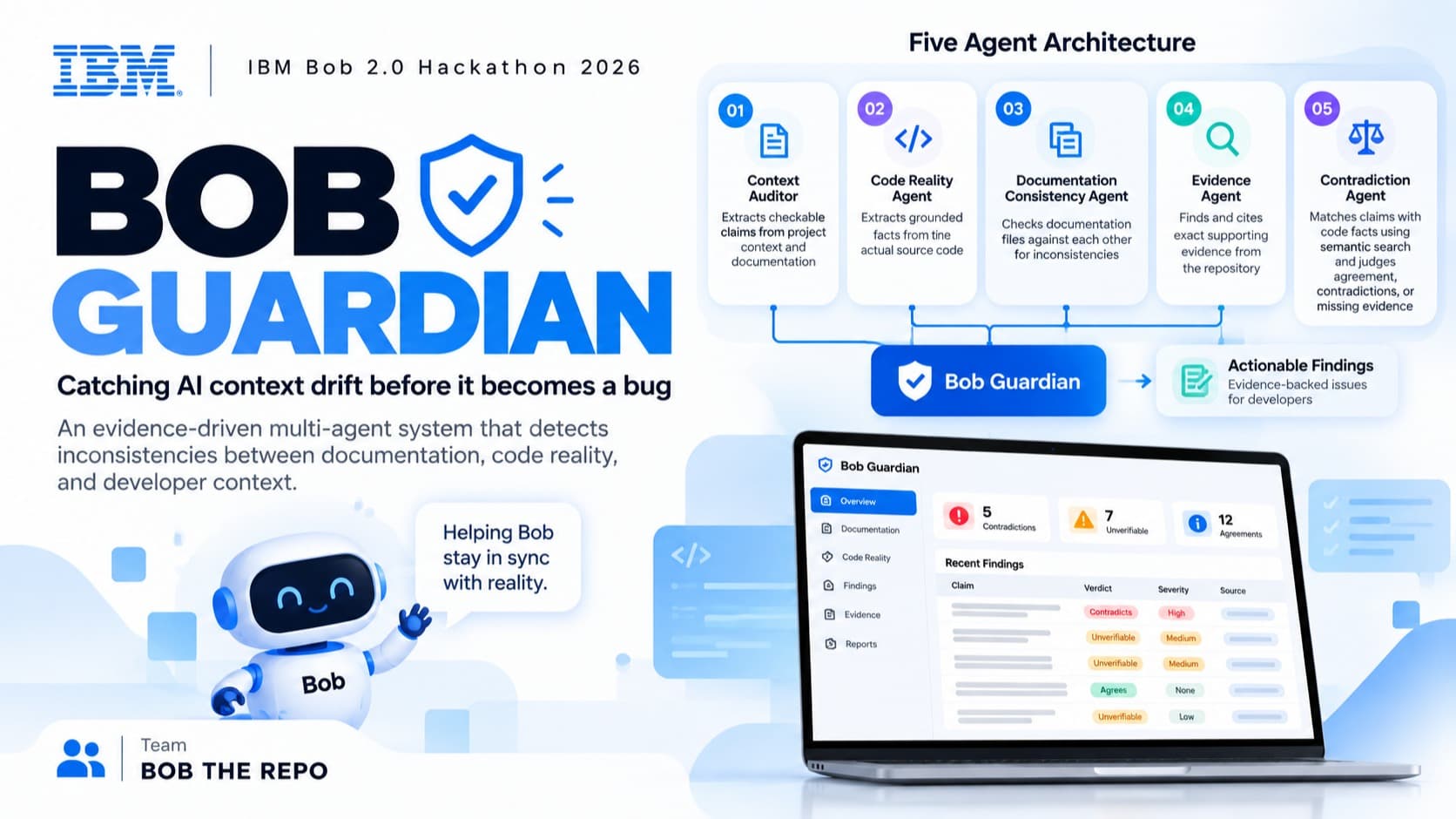
AI coding agents rely on project context such as AGENTS.md and README files to understand a codebase and make informed development decisions. The problem is that code evolves constantly while documentation and persistent context do not always keep up. This creates context drift: the AI may confidently act on information that was once correct but no longer reflects the real system. Bob Guardian is a multi agent auditing system designed to detect this gap between what an AI coding agent believes about a repository and what the code actually does. It uses five specialized agents. The Context Auditor extracts checkable claims from project context and documentation. The Code Reality Agent extracts grounded facts from source code. The Documentation Consistency Agent compares documentation sources to identify conflicting information. The Evidence Agent searches the repository for supporting or contradicting evidence. Finally, the Contradiction Agent uses semantic matching to connect relevant claims and code facts and determine whether they agree, contradict, or cannot be sufficiently verified. Our target users are development teams using AI coding assistants on evolving codebases. A developer can run Bob Guardian against a repository before important AI assisted development work or when project context may have become outdated. Instead of manually checking multiple documentation files against implementation details, the developer receives structured findings that highlight areas requiring attention. We tested the system using the Galaxium Travels application. Our reproducible demo includes an intentional test scenario where project context states that the backend runs on port 9090 while the code reality shows port 8080. The auditing pipeline can compare these pieces of information and surface the mismatch. What makes Bob Guardian different is the layer it audits. Traditional developer tools primarily inspect whether code itself is correct. Bob Guardian asks another question: is the AI's understanding of the codebase correct? By auditing the context and knowledge that AI coding agents rely on, Bob Guardian adds a verification layer between AI context and code reality, helping developers identify stale assumptions before they lead to incorrect implementation decisions, debugging, and rework.

Repo-Tutor

Repo-Tutor

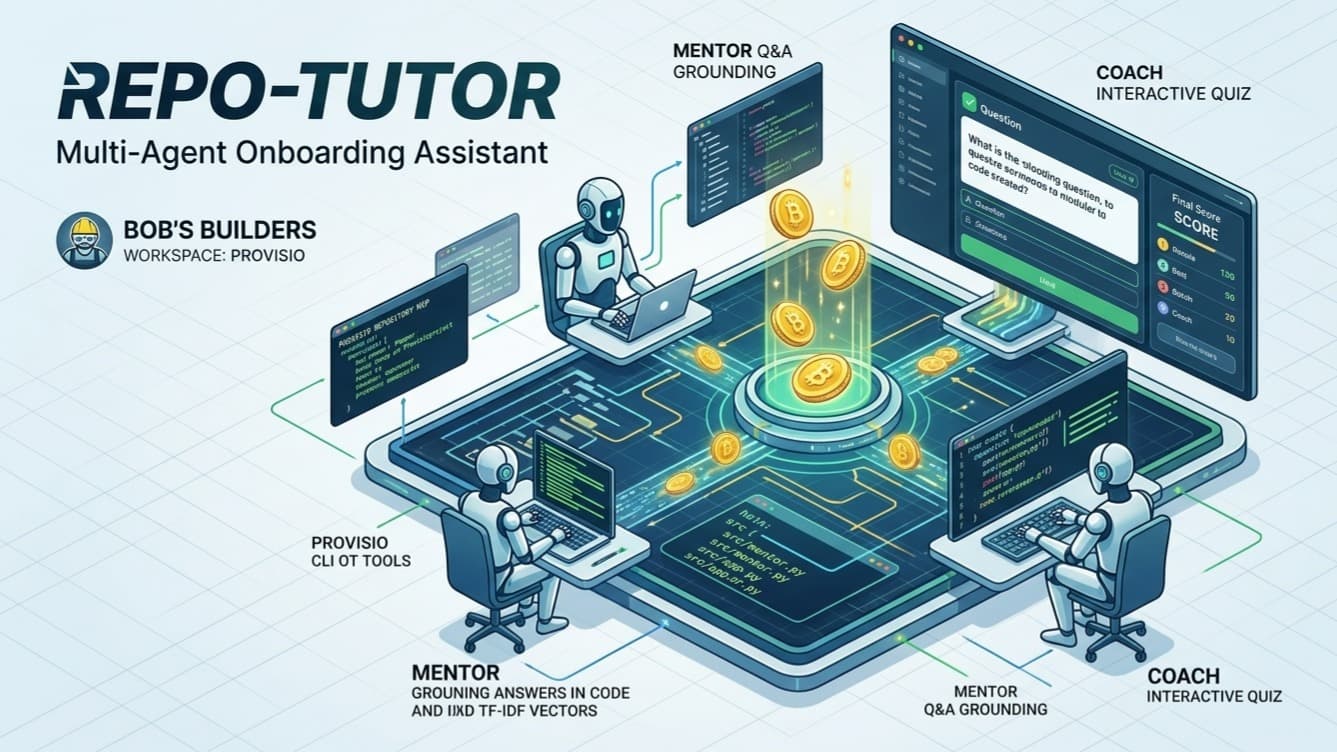
Problem Statement Onboarding software engineers onto complex codebases is time-consuming, expensive, and error-prone. Traditional onboarding relies on outdated documentation or senior engineer hand-holding. New developers often struggle to understand codebase architecture, locate critical components, and verify their comprehension without risking production code. Solution: Repo-Tutor Repo-Tutor (built within workspace Provisio) is a multi-agent AI onboarding assistant that turns static repositories into interactive learning environments. Designed for software engineering teams and technical leads, Repo-Tutor analyzes local codebases, answers natural language questions, and evaluates developer understanding through interactive quizzes. How Users Interact with Repo-Tutor Repository Mapping: The system ingests the codebase, building a structured AST and file-tree map without consuming LLM tokens. Interactive Q&A: Engineers ask codebase-specific questions (e.g., "How does error triage work?"). The Mentor Agent uses TF-IDF retrieval and dynamic context scaling to provide grounded answers with precise line references. Comprehension Assessment: The Coach Agent generates dynamic multiple-choice quizzes based on repo context. As developers submit answers, the system scores them in real time using strict keyword evaluation, providing immediate feedback and recommending targeted starter tasks. Why It Is Creative and Unique Repo-Tutor combines a zero-LLM local analyzer with intelligent LLM agent orchestrations. Instead of relying solely on generic LLM prompts, it uses hybrid retrieval (TF-IDF + Groq Llama-3.1 API) to prevent hallucinations. Furthermore, its interactive quiz and task recommendation engine actively tests comprehension rather than passively generating text, ensuring true onboarding readiness.

ProofPatch Fix bugs. Show proof.

ProofPatch Fix bugs. Show proof.

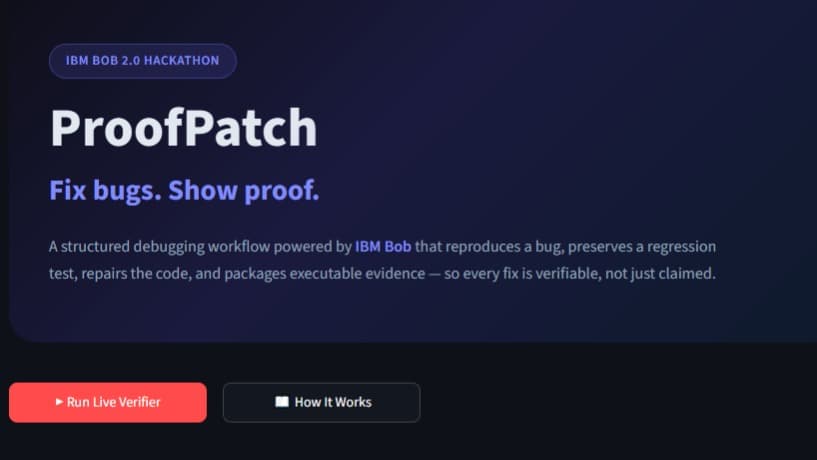
A reproducible verification workflow for AI-assisted repairs, built for the IBM Bob 2.0 Hackathon. The live app executes trusted bundled Python code; no AI service or API key is required. A pagination export drops task 4 when records share timestamps. ProofPatch connects a baseline assertion failure to a candidate repair, checks that mandatory tests and inputs are unchanged, and creates a rerunnable evidence package. A deliberately incorrect repair demonstrates rejection. The three CLI verifier commands return success when their intended outcomes occur. Raw pytest on the baseline or bad patch intentionally fails. python -m pytest defaults to verifier system tests, so routine project checks can finish green. On PowerShell set $env:PROOFPATCH_VARIANT="candidate" before the raw pytest command. The full suite always covers preview sizes 2, 3 and 4. Page size changes the independent ID preview only. Each subprocess has a 15-second limit; one candidate verification can take roughly 45 seconds in a worst-case sequence of timed-out children. The web UI is synchronous during a run. report.json, summary.md, patch.diff, full baseline and selected stdout/stderr, JUnit XML, checksums.json, and snapshot/ containing all executable sample code, regression and acceptance tests, fixture, conftest.py, configuration, requirements and frozen manifest. Run summary.md instructions from snapshot/ to reproduce the checks. The manifest detects accidental or unreviewed changes relative to a local reference. A maintainer who changes both manifest and files can change that reference. SHA-256 hashes are not signatures, authorship proof, or trusted timestamps. This release manifest was created after the original build. Original Bob provenance must be established with the team's actual session artifacts. Never regenerate the manifest just to bypass a failed integrity check. Creating a new manifest requires a complete matching suite, a reproduced baseline assertion and a passing candidate. Existing evidence remains bound to its own snapshot. The dataset is synthetic and the bad patch is an intentional negative control, used to test rejection. The verifier accepts only bundled variants; it is not an execution sandbox for arbitrary uploads. The repaired pagination code assumes unique integer IDs and comparable datetime values. It reads an in-memory dataset and is not a production database adapter. Performance and commercial benefits beyond observed local runs remain hypotheses. We used IBM Bob during our original development. After our allocated credits were consumed, we continued local engineering and testing with Codex assistance. See PROVENANCE.md for the contribution record. MIT license applies to the team's original project code; dependency licenses remain their own.